Come Visit Me at the Woodlawn Street Market

Screen shot 2015-04-08 at 11.25.40 AM

This week, I’m in full production mode as I prepare for the Woodlawn Street Market this Saturday. I’m bringing with me lots of felt food and hopefully (time depending) lots of felt cactuses and (brand new) felt succulents!! So if you’re in Birmingham this week, come by and visit. I would love to meet you and talk shop!

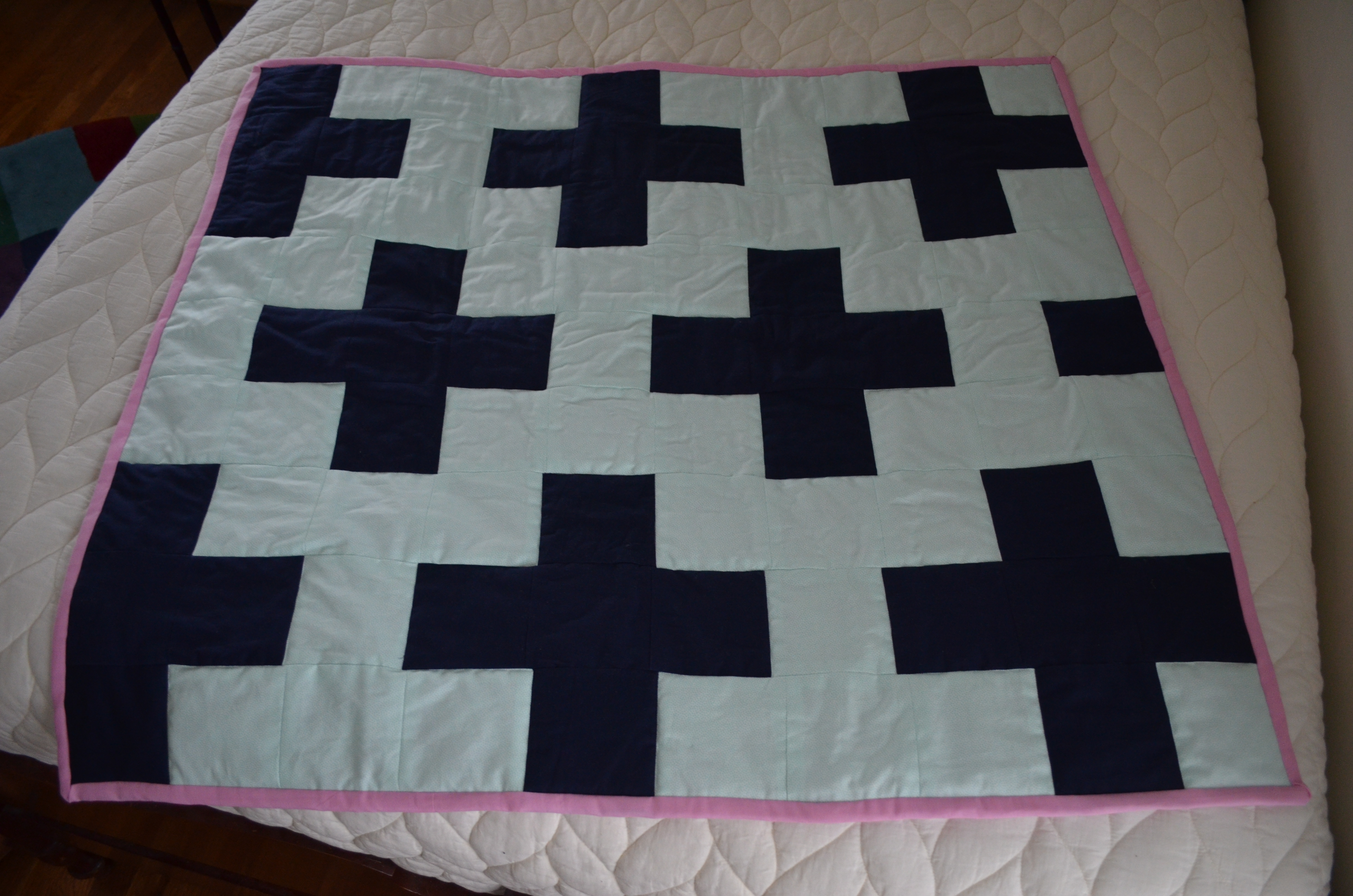
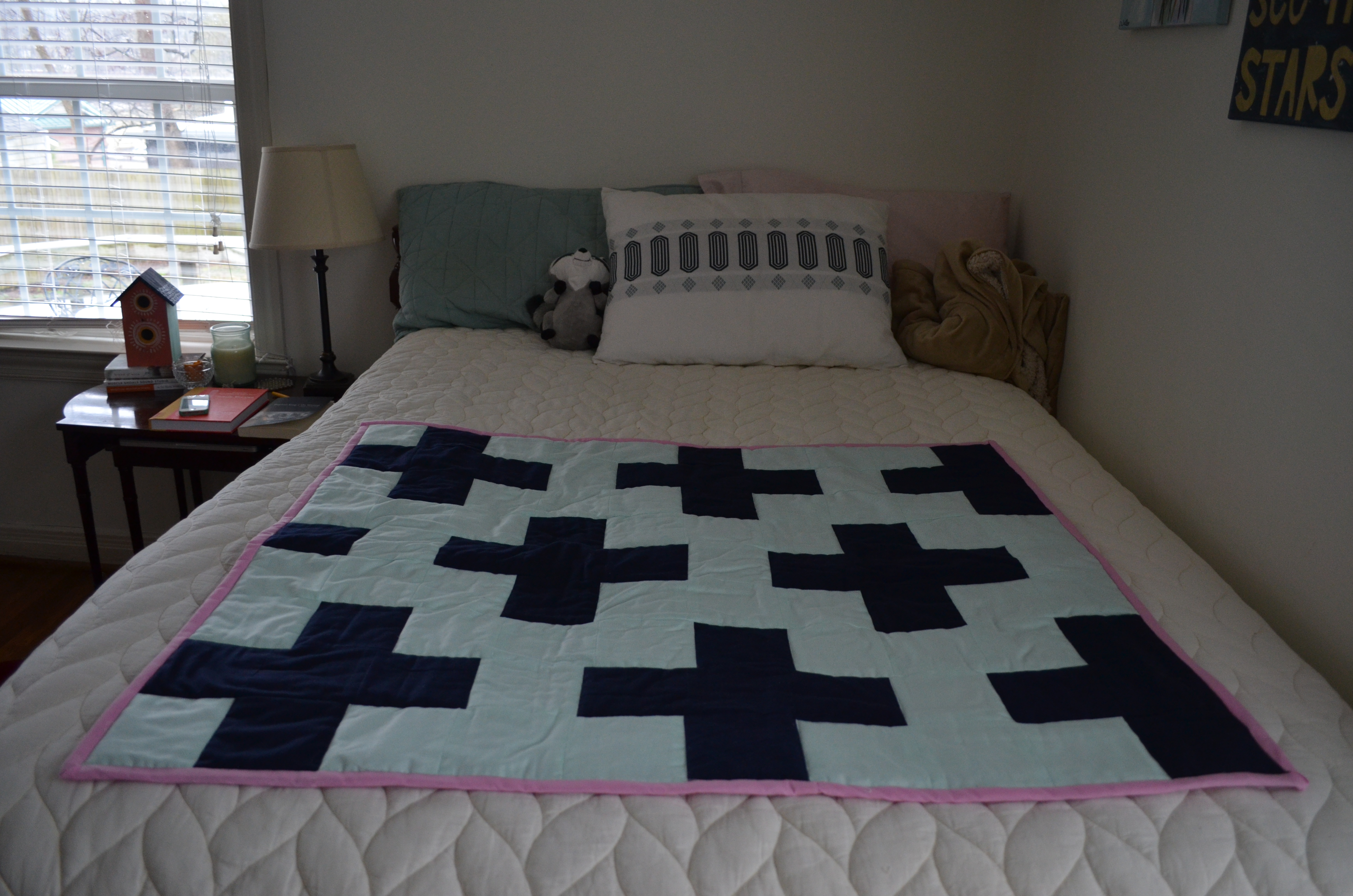
Modern Plus Pattern Baby Quilt

DSC_0800

Dear reader, I specifically told you in my last blog post to remind me not to start a new quilt. You dropped the ball. I recently made a baby quilt. Okay, okay, so this has more to do with my lack of self control than your accountability. My little niece was born in January, and I had been itching to meet her, so to help temper my longing heart, I started cutting out squares of fabric.

IMG_5269

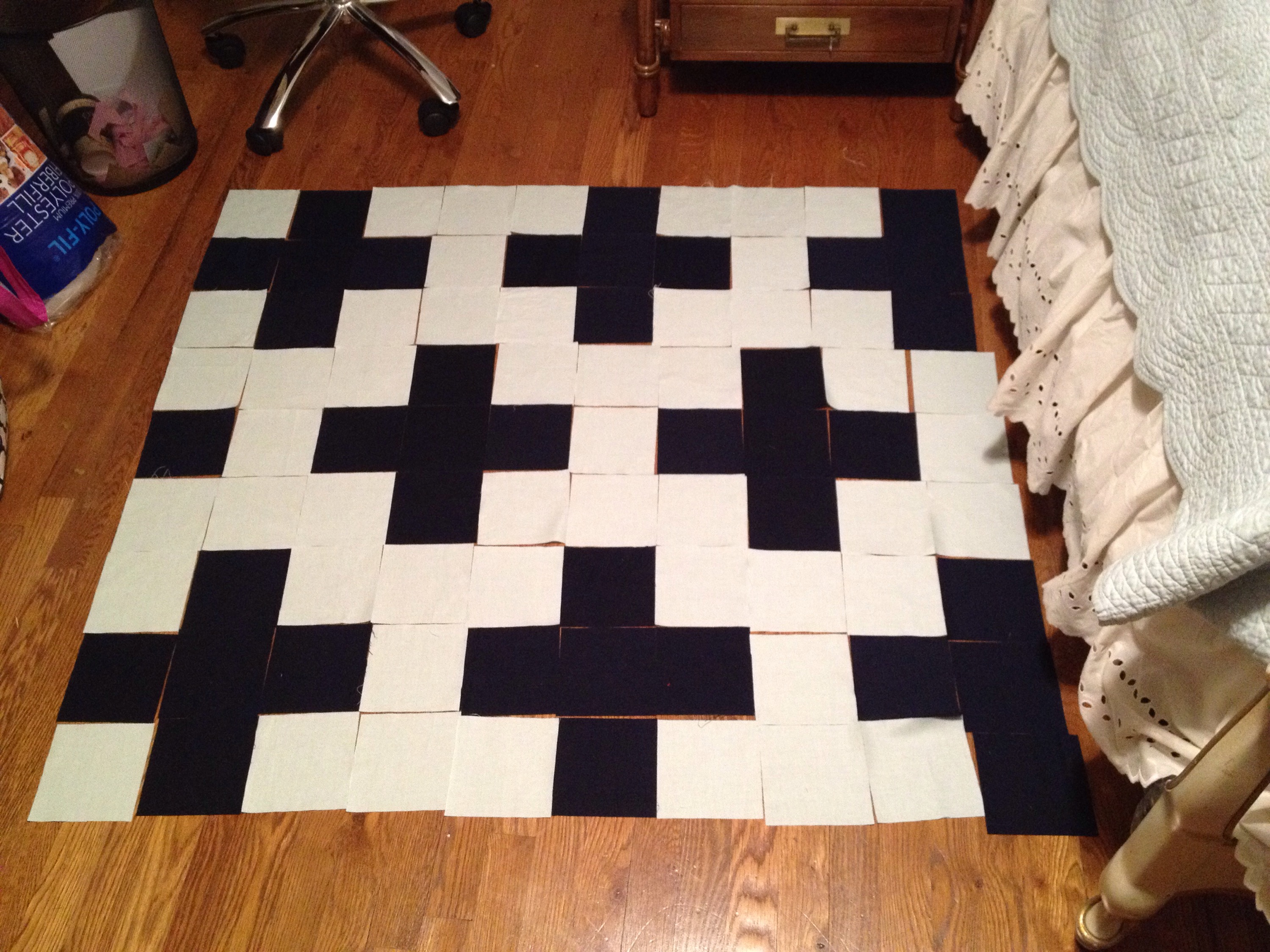
Ninety squares to be exact. For baby quilts, I base the dimensions on a standard yard of fabric – 36 x 44 inches. So I cut 5-inch squares out of two different fabrics: a navy solid and a light blue print. (Totals = 39 navy squares and 51 light blue squares)

IMG_5271     IMG_5272

This quilt is a great pattern for beginners because you’re working with squares and straight lines.

After cutting the 5-inch squares, arrange the pattern on a flat surface (in my case, it’s the floor). Begin sewing the squares together a row at a time (always right sides together). I used a 0.5-inch seam allowance with the basic walking foot on my sewing machine. Then sew each row together. Stop periodically to iron the seams, and after sewing on the last row, iron the entire piece.

DSC_0783

It is important to take the time to iron the seams. For this quilt I used the quilting technique called “stitch-the-ditch” (I explain further down), and you need your seams to lay flat for this technique to work. Before moving on to the next step, also take the time to cut off the loose thread from the seams.
DSC_0787

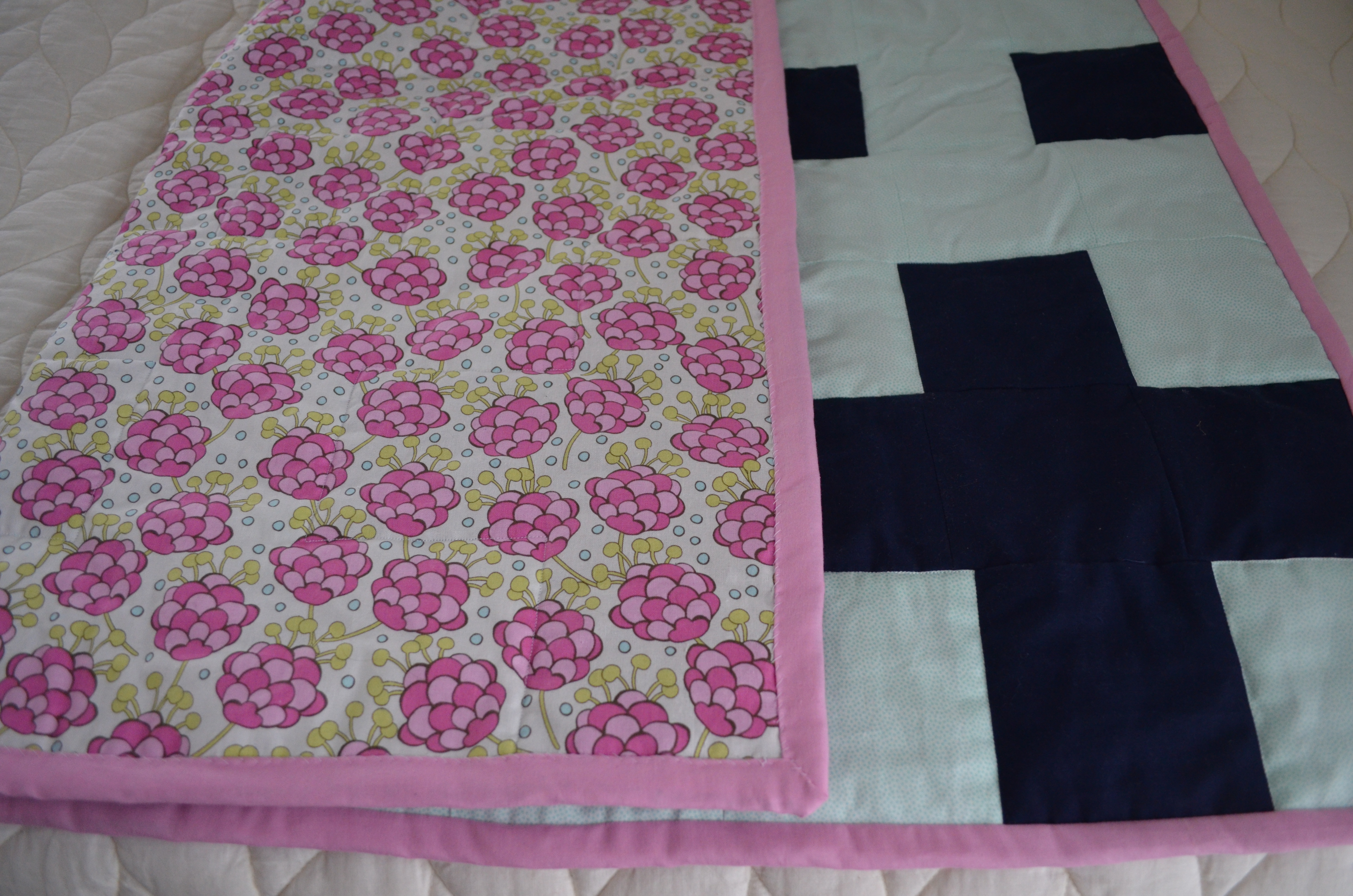
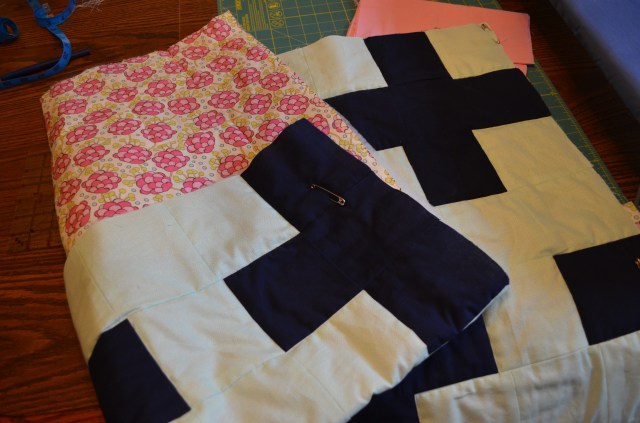
Now that you have created the front piece of your quilt, the next step is to layer the three pieces together and start quilting. I found an adorable floral print for the back piece. It’s a standard yard (36 x 44 inches).

First, take the piece of batting and lay it on a flat surface (again, I use the floor). (I bought a crib-sized piece of polyester batting.) Take the front piece and lay it on a flat surface, with the wrong side facing up. Spray with temporary spray adhesive and let stand for a minute or two (this step is best to do outside). And then lay the front piece on top of the batting, smoothly the fabric as you lay it down. (It’s helpful to have a friend hold up one end as you smooth.) Flip the batting over and do the same with the back piece of fabric. (The back piece is a larger piece of fabric, but still make sure it lines up with the front piece. Once complete, I pin safety pins around the quilt as a precaution to keep the fabric in place.

The next step is quilting! Using the “stitch-the-ditch” quilting technique, you sew along the existing seam, creating a quilting pattern that matched the front piece. For this quilt, I sewed along the outline of each plus sign.

DSC_0791

Once complete, cut off all loose thread as well as any excess fabric that extends beyond the length and width of the front piece.

The final step is calling binding, the creation of the quilt’s edge. Since I had a lot of blue in a quilt made for a girl, I went with a pink binding. (I think it’s important to pick a color or fabric that helps connect the pattern and colors of the front and back pieces.) First, cut out several 2.5-inch strips, and sew them together so the fabric measure the lengths + the widths of the quilt. (I can’t remember the exact dimensions.) Iron down 0.5 inch on one side, and then pin the strip of fabric to the front side of the quilt (remember, always rights sides together).

DSC_0790

When you get to a corner, keep the fabric aligned with the edge, folding at the corner so the fabric overlaps (hopefully the picture can help explain). With the fabric in place, sew along the quilt’s edge with a 0.5-inch seam allowance. As you approach, stop sewing about 0.5 inch from the corner. Remove the needle from the quilt, and turn the quilt 90 degrees. Because of how you folded the fabric strip, you’ll have a excess triangle of fabric. When you put your needle back into the fabric, make sure that excess triangle is out of the way.

This process is hard to explain, but trust me, there are a ton of YouTube videos out there that are very helpful (especially for those who are visual learners like me).

With the one edge of the binding in place, I fold the fabric over the edge and whip-stitch the other side in place. (It’s a long process, but I find it easier that machine binding the whole thing!)
IMG_5276

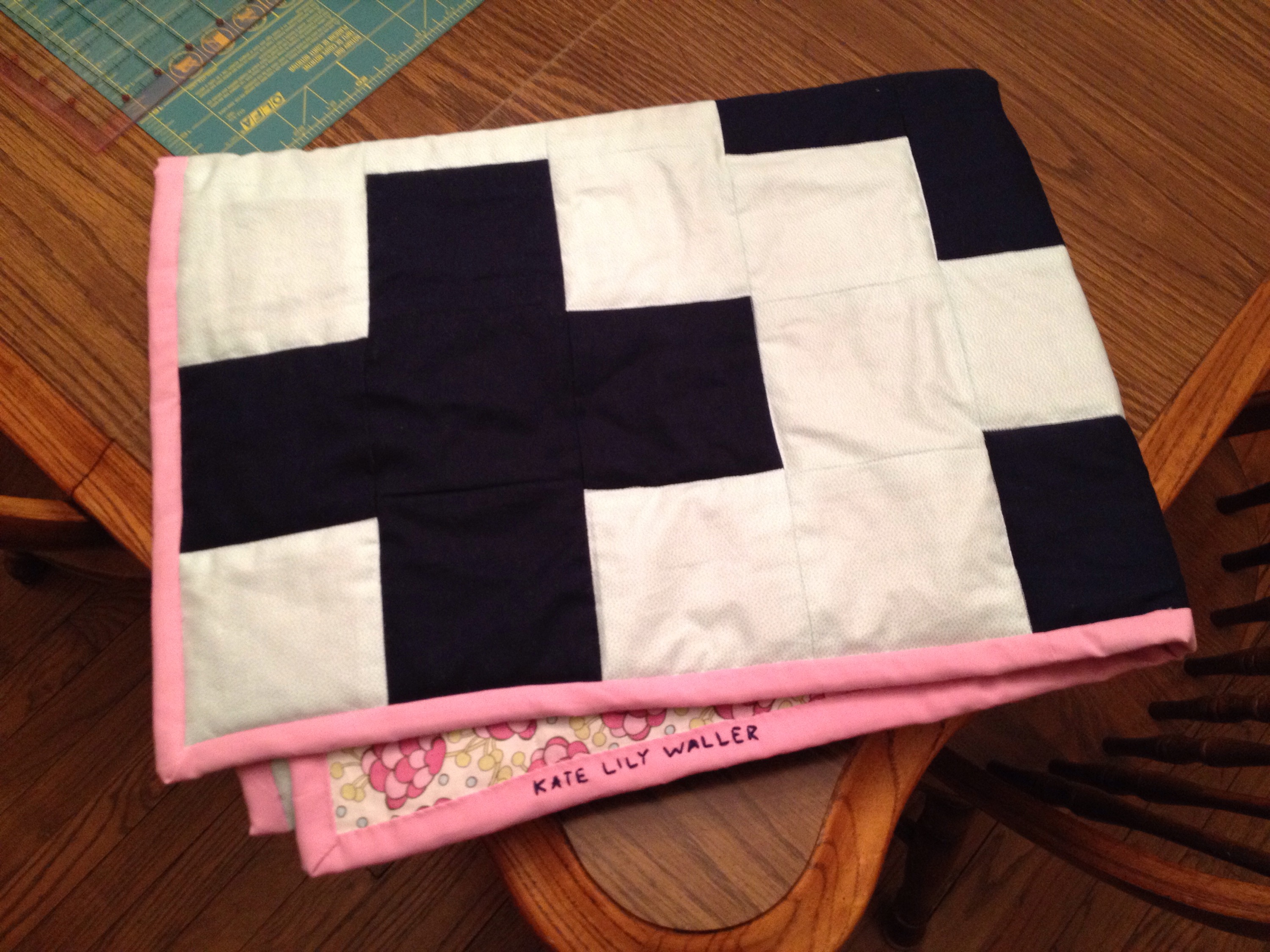
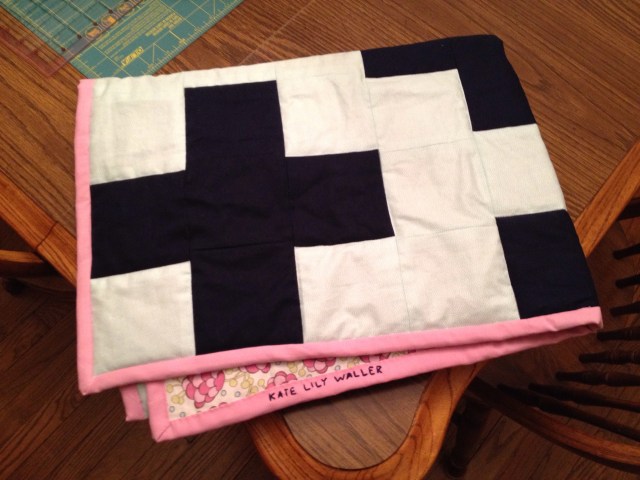
Before I finished the binding, I took a moment to embroider my niece’s name. These personal touches make all the difference!

DSC_0802

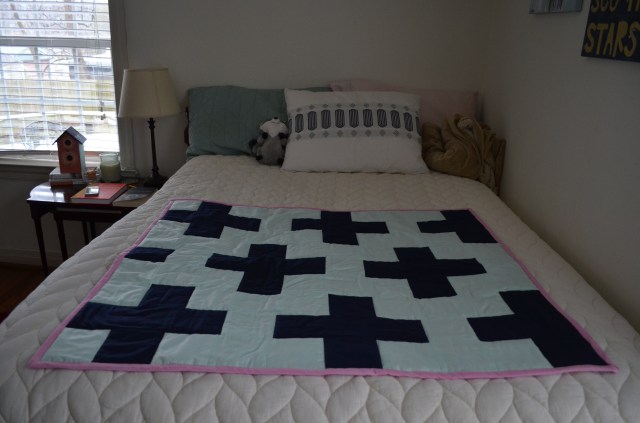
I love the modern twist to the classic gift of a baby quilt. (And I’m a huge of the navy, blue and pink combination.) I did finally get the chance to meet my little niece, and she looks crazy cute wrapped up in this!
DSC_0793

Piecing Together a Dresden Plate Quilt

IMG_3849

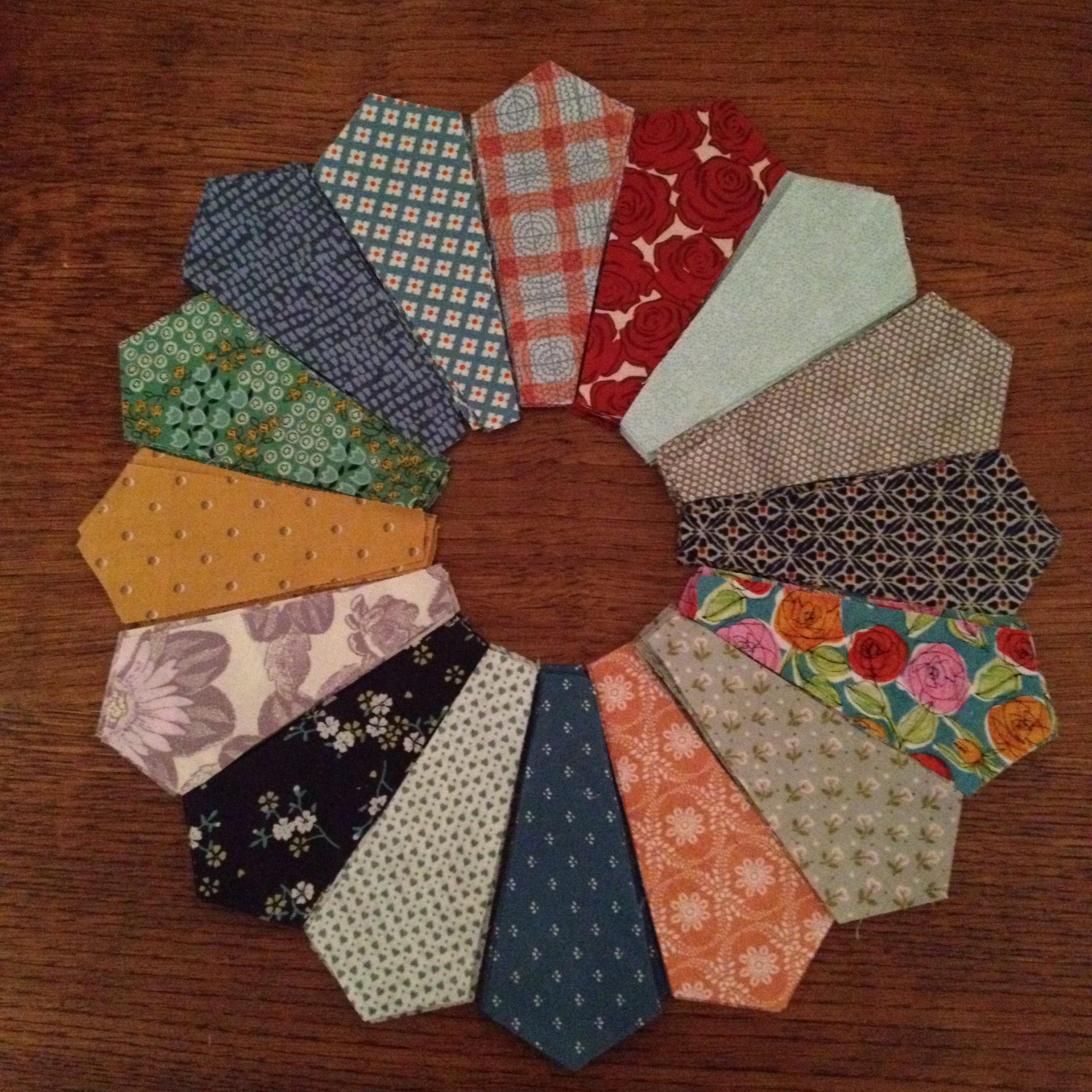
It was about this time last year that I took this picture. It was in the midst of Birmingham’s Snowpocalypse 2014, and with the office closed and roads a mess, I had nothing better to do than start a quilt. Now – more than a year later – I found the motivation to pick up where I left off with the hopes of finishing my first full-size quilt before the end of March.

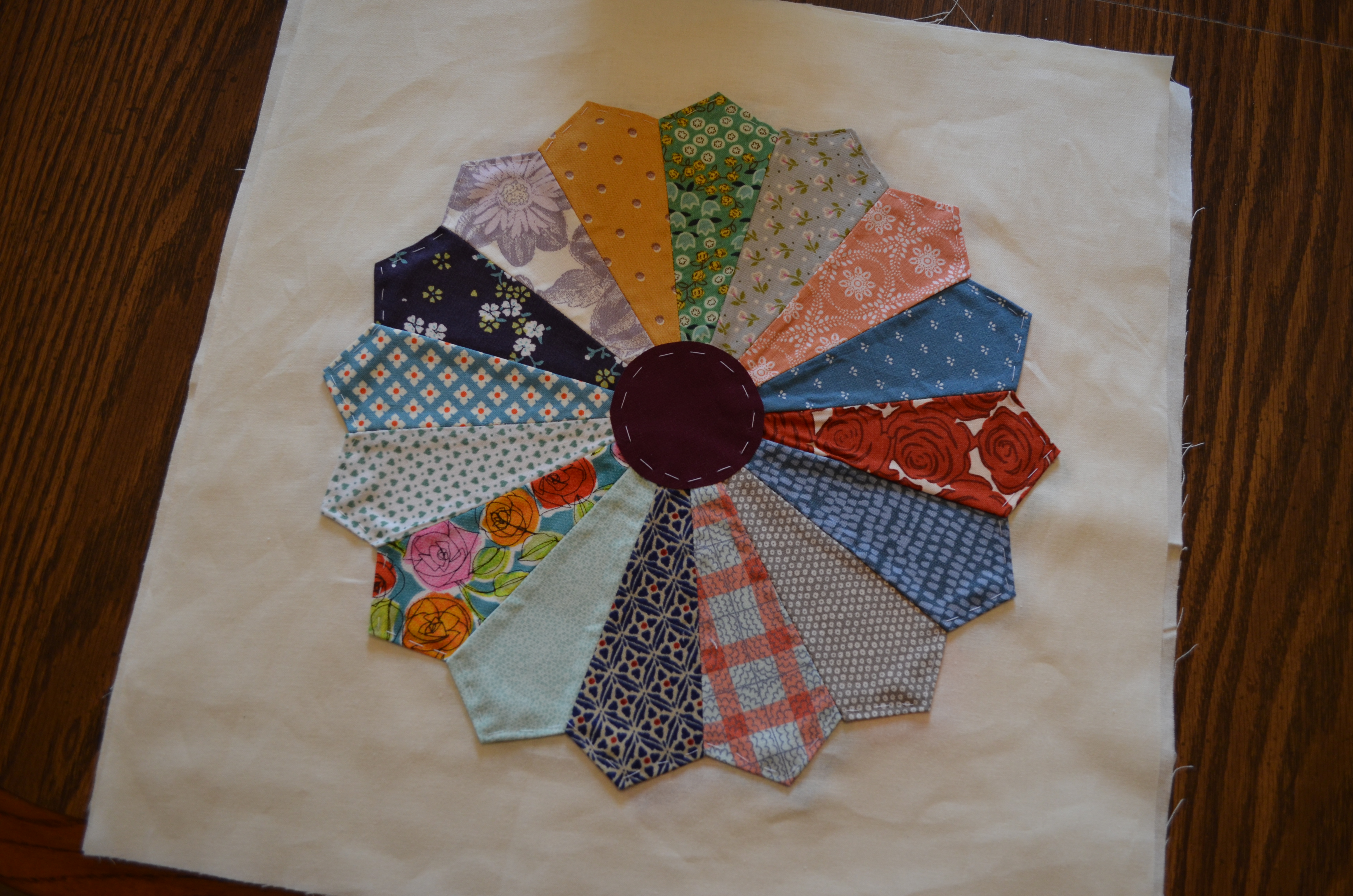
The pattern is called the Dresden plate. (I also heard it be called the flower or floral plate.) The idea has been floating around in my head ever since I finished my last quilt (as my Pinterest board can attest.) Finally, I bit the bullet (a year ago) and purchased the template blocks and got started.

IMG_3852      IMG_3854

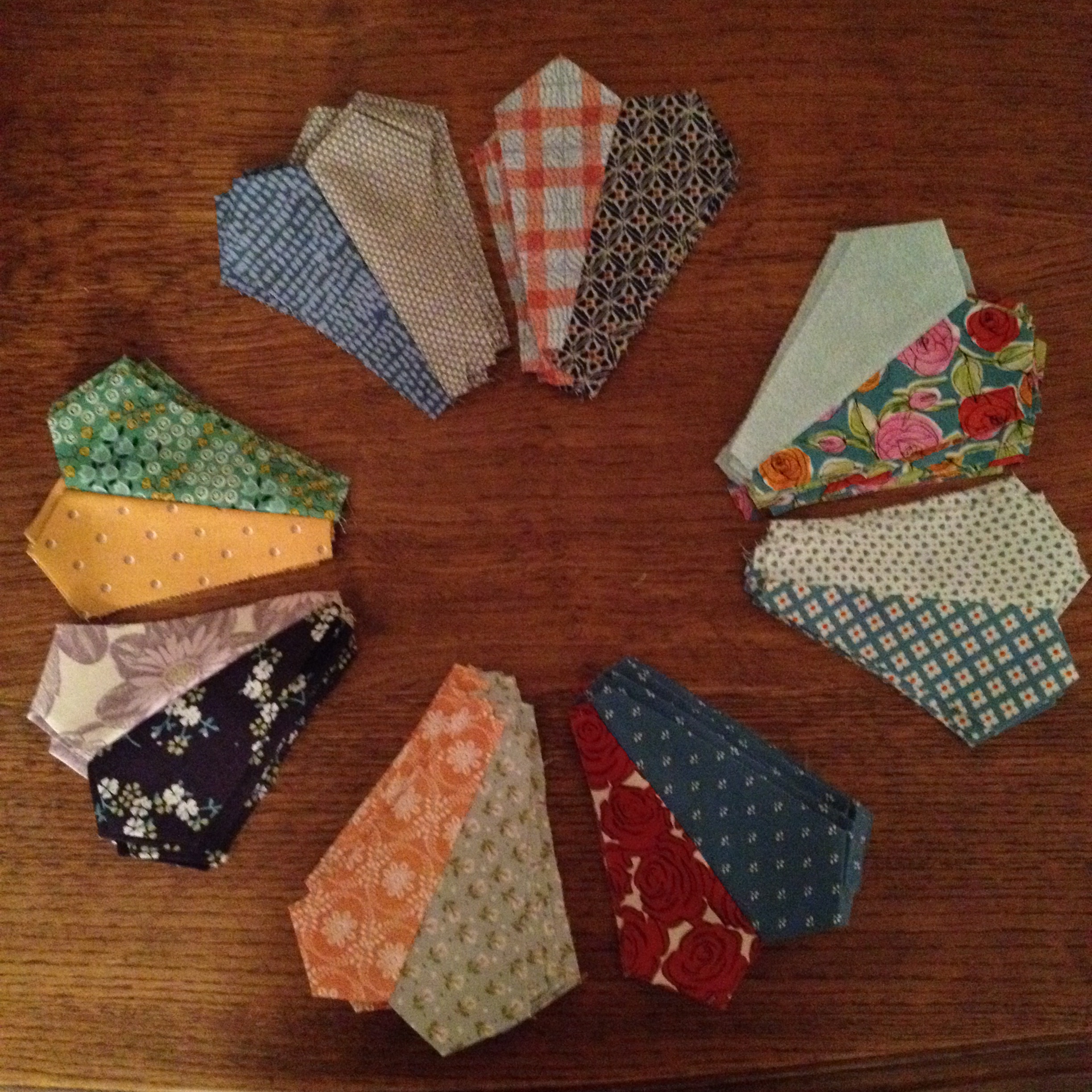
Piecing this pattern is a two step process that involves a lot of ironing. Step one: cut out the pieces. I used the template, a rotary cutter and mat to cut out each piece. I then took the top of each piece (where the fabric comes to a point), folded over a 1/4 inch seam allowance and pressed the seams. Step two: sew pieces together in sections. Instead of sewing the ring together piece by piece, it is much easier to work in sections: sewing pieces into pairs – stop and iron – then pairs to quarters – stop and iron – quarters to halves – stop and iron – and finally 2 halves into 1 whole circle.

DSC_0693

With a plate completed, the next step is to applique it to a block of fabric. For my quilt, I cut each block to measure 15 x 15 inches.

DSC_0696

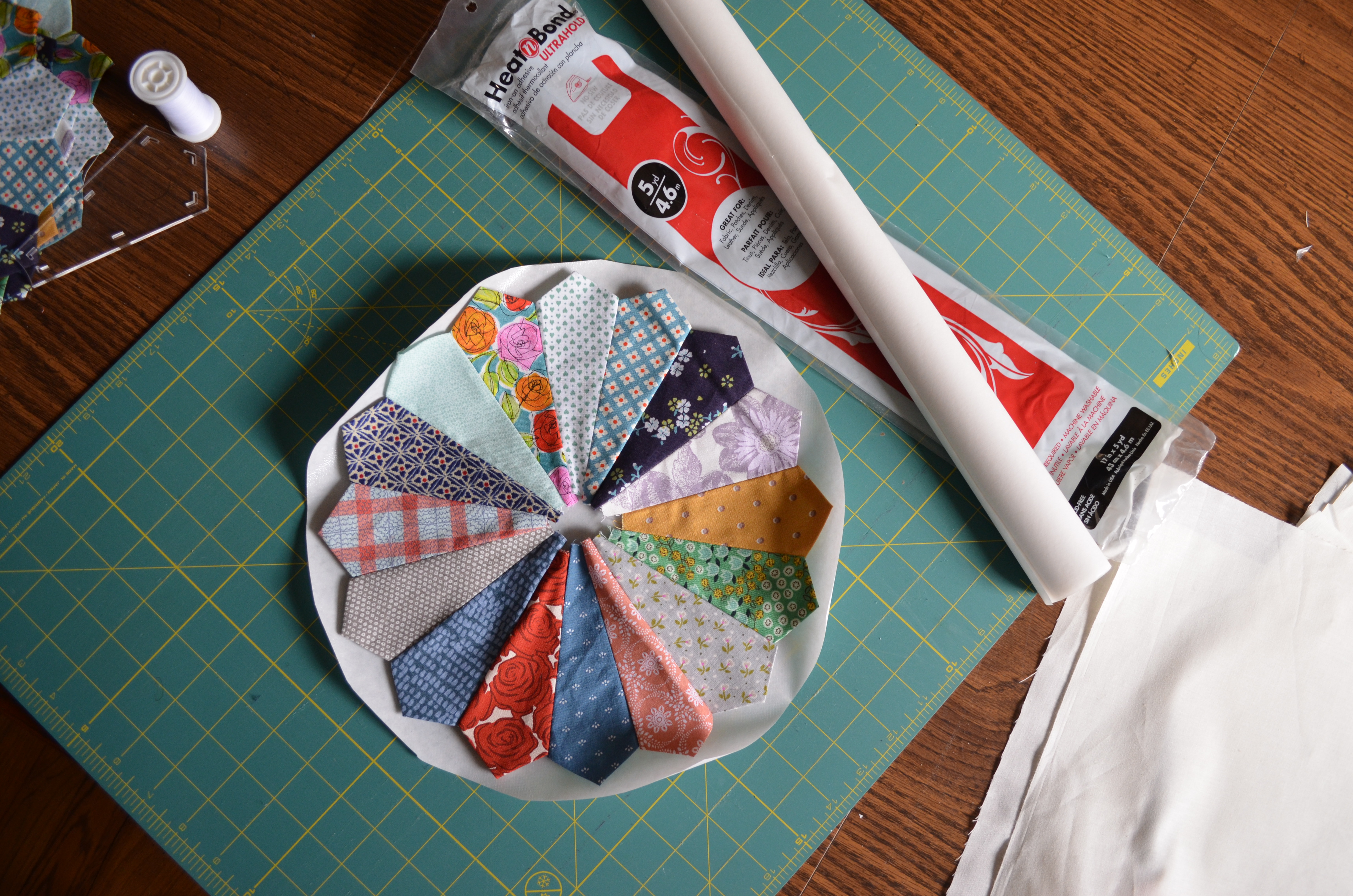
Now some tutorials will show you how to hand-applique the plate in place, but I decided to cheat and use heat n’ bond iron-on adhesive. I cut a piece of adhesive to be smaller than the plate, leaving the outer points untouched. (A downside of using iron-on adhesive is that it will make the fabric stiffer, but I find it so helpful in keeping the fabric in place.)

DSC_0698

After ironing the piece of adhesive to the plate, I peeled off the back side, placed the plate in the center of the block and ironed it in place.

DSC_0702DSC_0703

Next, I cut the center circle. Instead of pressing the seams, I decided to use the heat n’ bond to avoid frayed edges. (This may back fire on my one day, but for now, it makes this step super easy.) I simply ironed the circle in place.

DSC_0705

Finally, I hand stitched the outer edge and center circle to help secure everything in place. (Plus, I think the stitching enhances the overall look.)

DSC_0714

For my quilt, I need 35 of these blocks, and I have made 10 so far. So I have quite the feat in front of me. In the meantime, feel free to visit my Patchwork Pinterest board. (And remind me I cannot start a new quilt until I finish this one!)

Smitten Kitchen’s Cinnamon Toast French Toast

DSC_0713 2

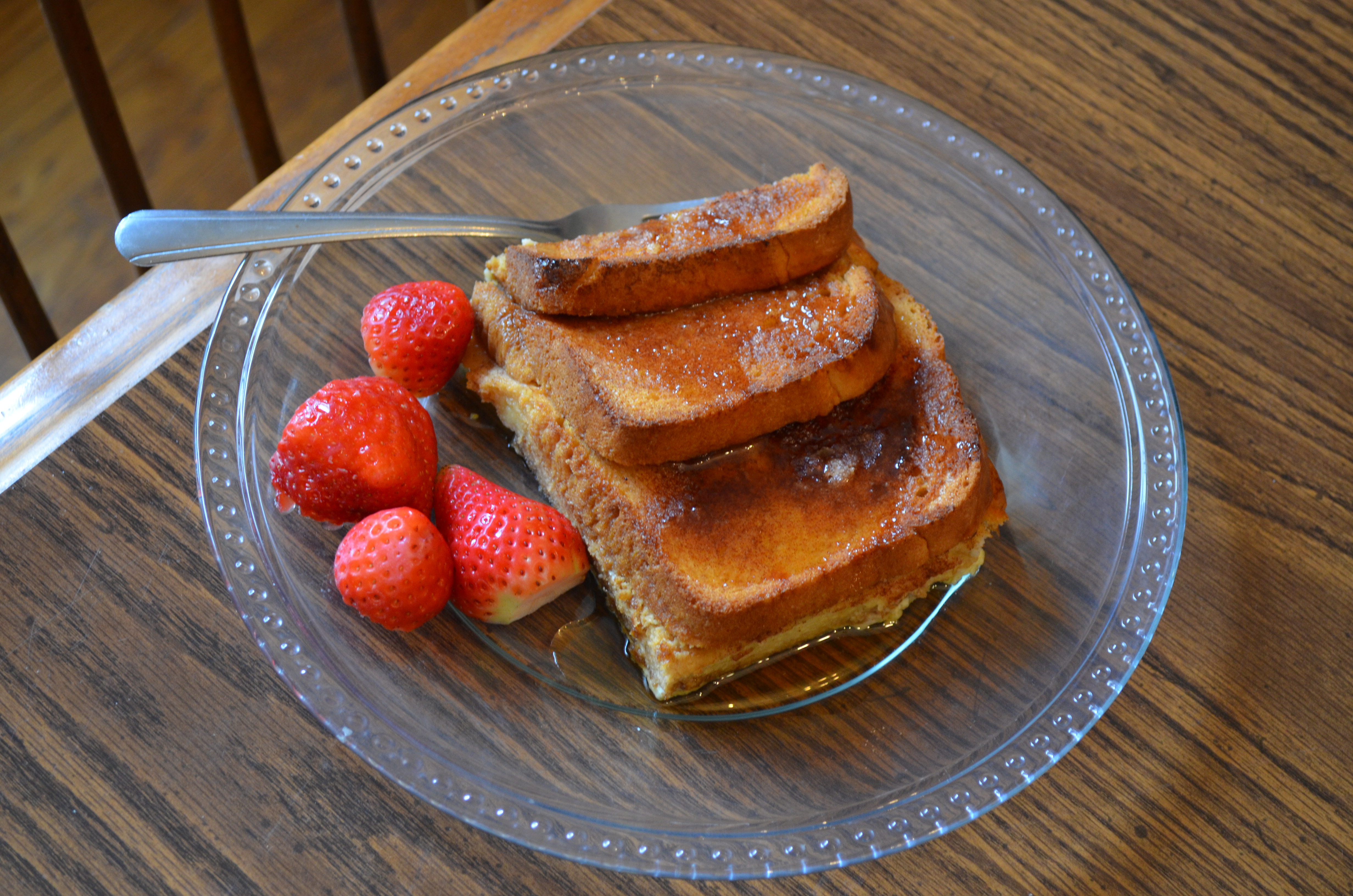
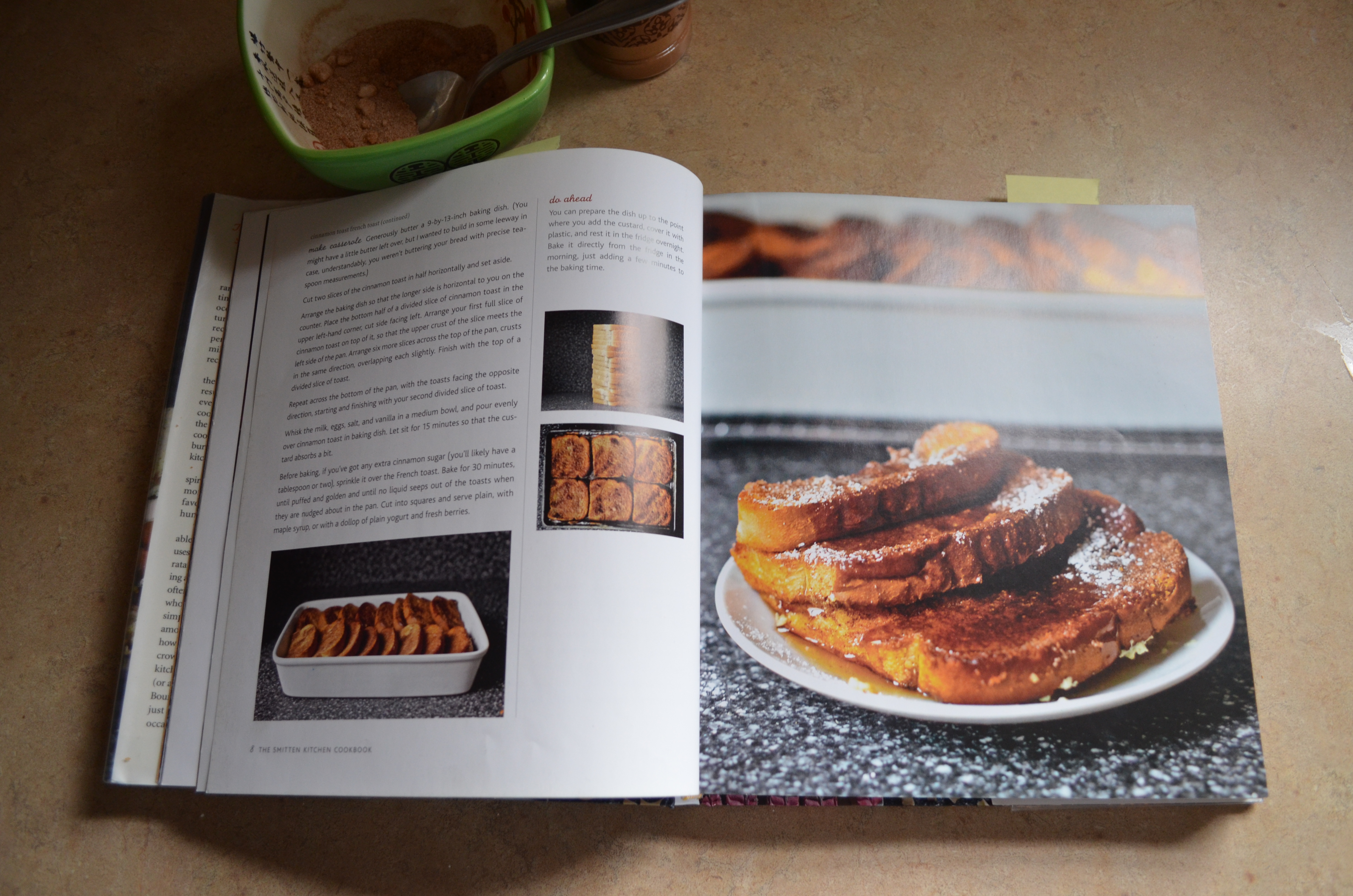
Last week, I came home from the library with The Smitten Kitchen Cookbook, a book that came highly recommended by a friend. These days, my day job keeps me well stocked in cookbooks, so when it comes to purchasing one myself, I like to test it out first. Based on a blog, this cookbook is wonderfully visual, and it lays flat (which I love in a cookbook). My first recipe to try was its Cinnamon Toast French Toast, and to put it simply, it was a winner!

Ingredients:

  • 1 tablespoon ground cinnamon
  • 1/3 cup sugar
  • about 1-pound loaf white sandwich bread (I used 12 slices)
  • butter or margarine (to spread)
  • 3 cups milk
  • 6 eggs
  • 1/2 teaspoon salt
  • 2 teaspoons vanilla extract
  • Maple syrup and strawberries (for serving)

DSC_0695

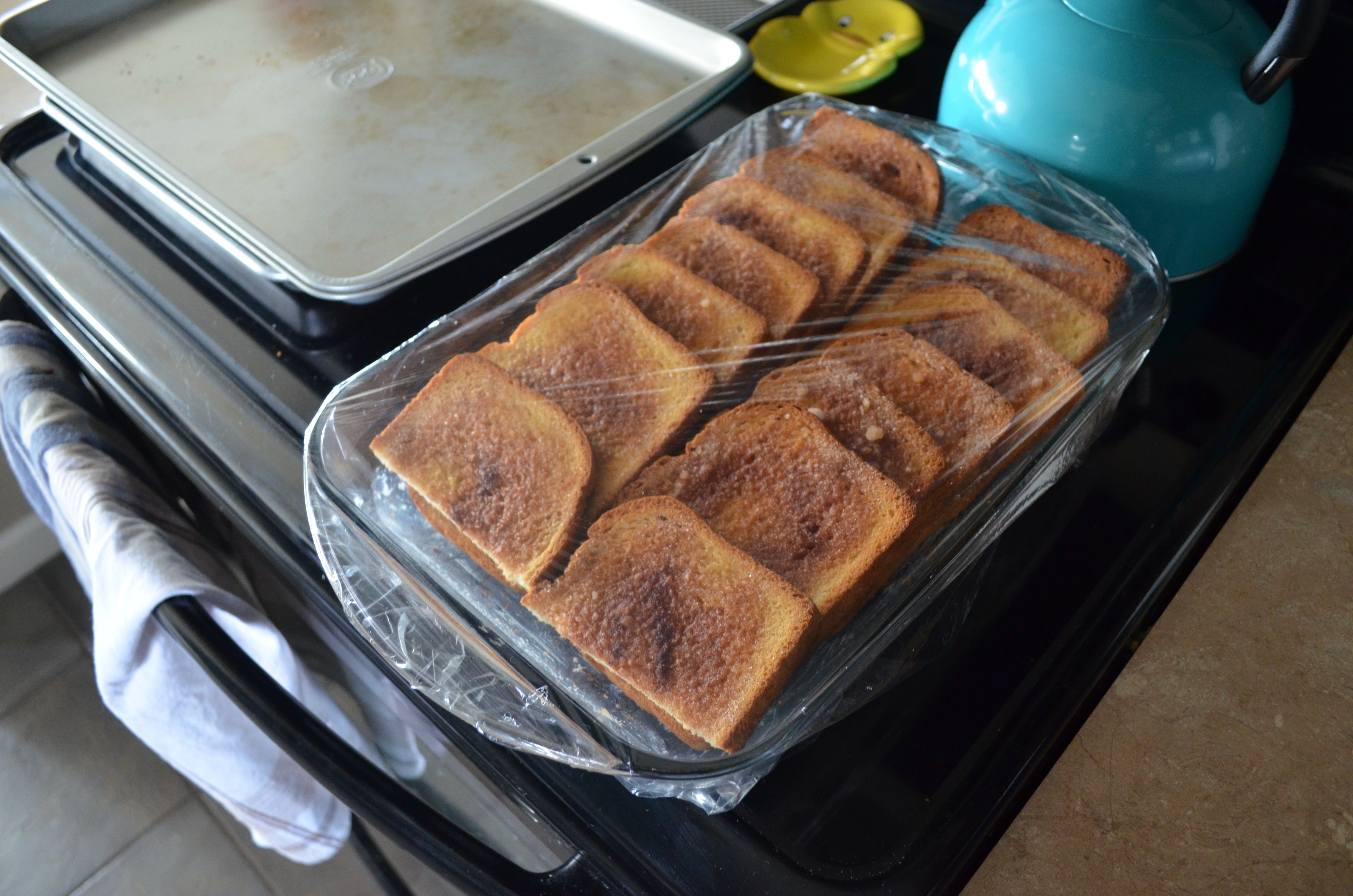
My no. 2 reason for loving this reason (no. 1 being how delicious it turned out) is the fact that I can make most of it ahead of time. The night before I made the cinnamon toast.

Preheat the oven to 450 degrees. Combine the cinnamon and sugar in a small bowl. Place the slices of bread in a single layer on 2 parchment paper-lined baking sheets. Spread butter on the top  of each slice of bread, and sprinkle with a spoonful of cinnamon-sugar mixture. Toast the trays of bread, about 7 to 10 minutes. Remove for oven, and let cool.

Generously butter a 9- x 13-inch backing dish. Arrange the bread in the pan. Cover with plastic wrap and store in the refrigerator overnight.

DSC_0699 2

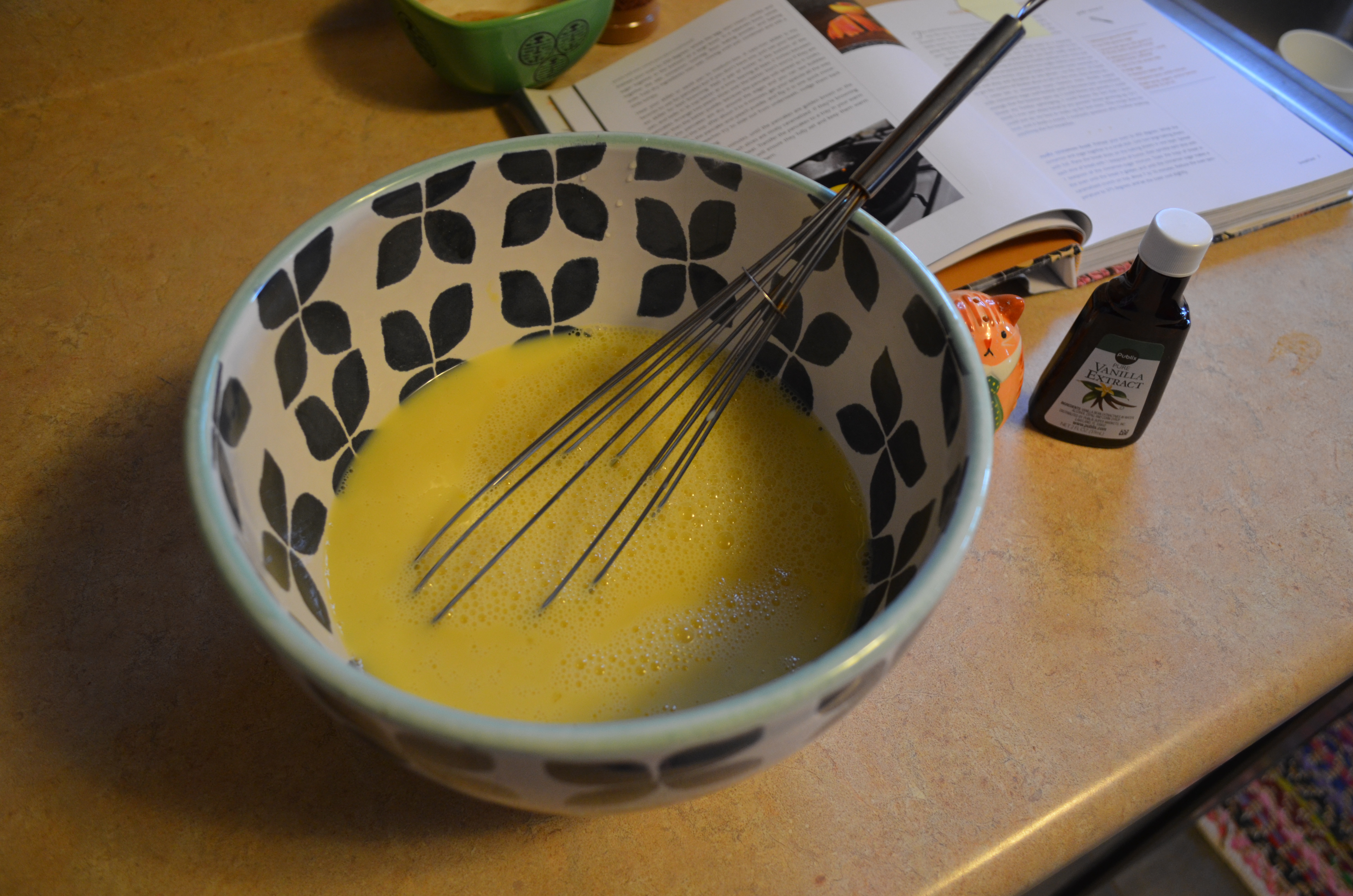
The next morning, I let the pan come up to room temperature as I whisked together the milk, eggs, salt and vanilla in a medium bowl. I then poured it evenly over the cinnamon toast and let it sit for 15 minutes (to give the bread time to absorb the custard).

DSC_0701 2

Next, bake for 30 minutes, until golden and egg mixture looks firm. Cut into squares and serve.

DSC_0706 2

For garnishes, I went with something simple: sliced strawberries and warm syrup. I set out extra cinnamon-sugar, but I don’t think anyone went for it. (The recipe has enough sugar as it is.)

DSC_0694
The same weekend, I tried a recipe for Brownie Roll-Out Cookies that turned out equally delicious. So long story shot, the book is in my Amazon shopping cart (just wanting to qualify for free shipping)!


Applique Lake Lanier Pillow

DSC_0667

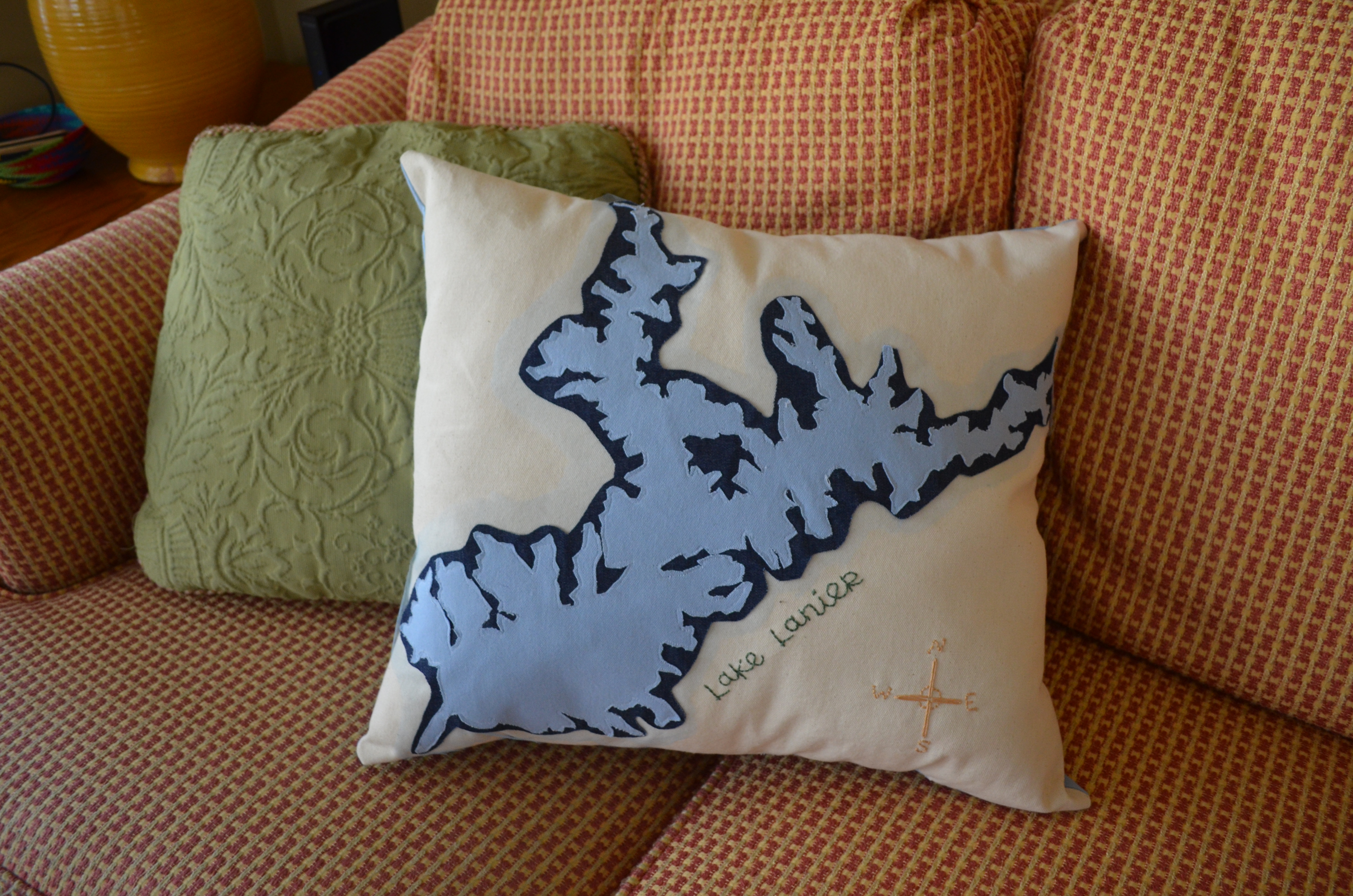
There is a point early on in a sewing project when you just know that the final product is going to be fantastic. This idea – a pillow with a map of the lake my parents live on – had been floating around in my head for months. And finally, back in December (yes, this is another overdue post) I finally put the plan into action. One day at work, I found a map online that I eventually used as my template. It was that early on – before I had even picked up a piece of fabric – that I knew in my heart this pillow was going to turn out awesome!

I think it turned out to be just that.

DSC_0634

I used the map I found online as a compass, pointing me in the direction I should take the project. The map’s size decided the dimensions, and its green outline inspired me to use layers of fabric.

DSC_0635    DSC_0636

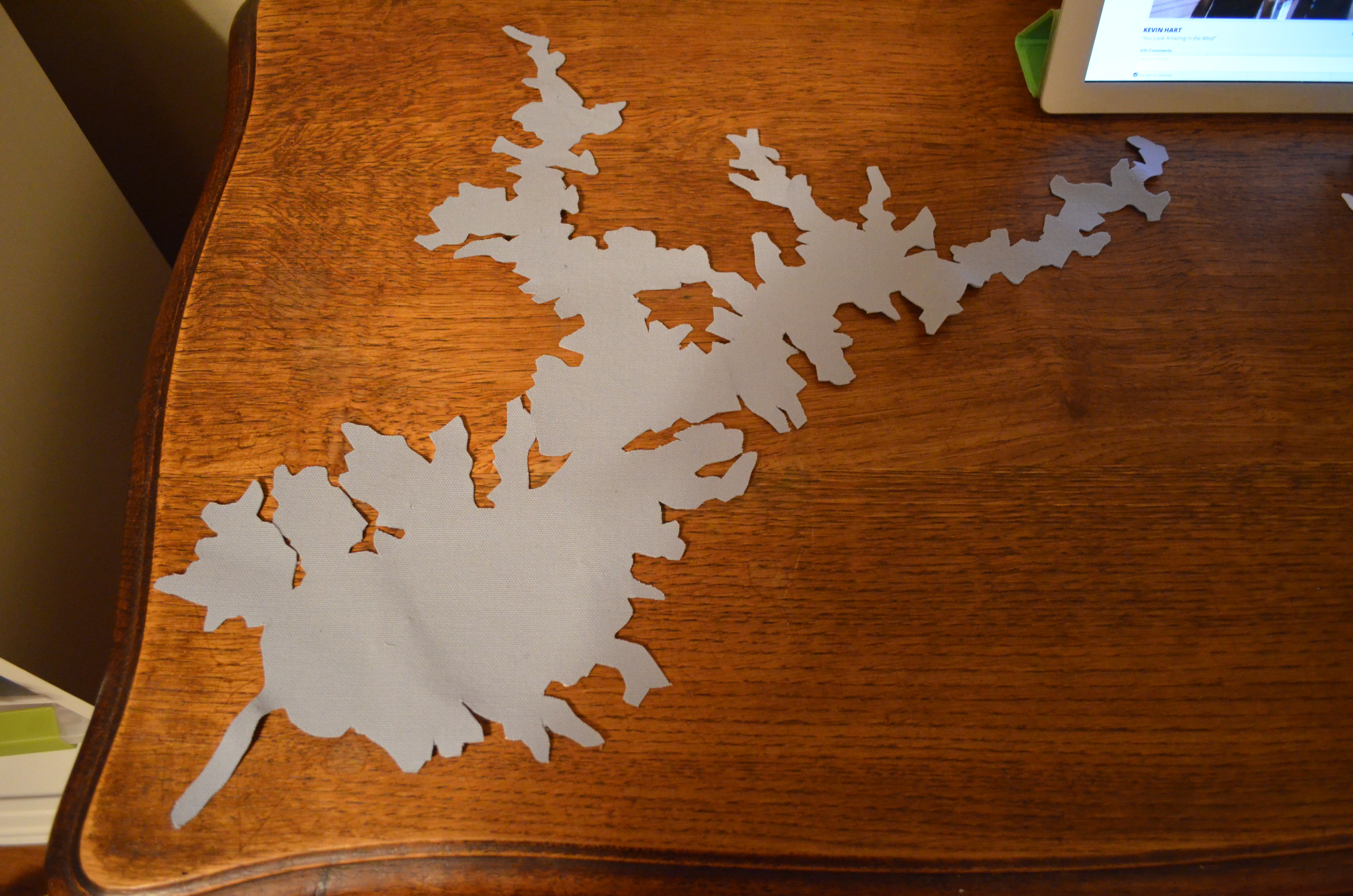
The pillow’s map has 3 layers of fabric. The first (though it may be hard to see in the pictures) is a layer of light blue tulle. The second layer is a dark denim material someone gave me as scraps. Using heat n’ bond iron-on adhesive, I cut out a rough outline of the map without the worry of fraying edges.

DSC_0644    DSC_0645

Finally, the third piece is the most detailed. Again using heat ‘n bond iron-on adhesive, I pined the map to the fabric and cut out the map along the green border. (I thought if I cut any closer, some of those tiny coves would be crazy difficult to cut out.) This piece took awhile to cut because I went nice and slow. I didn’t want to make any mistakes.

DSC_0647

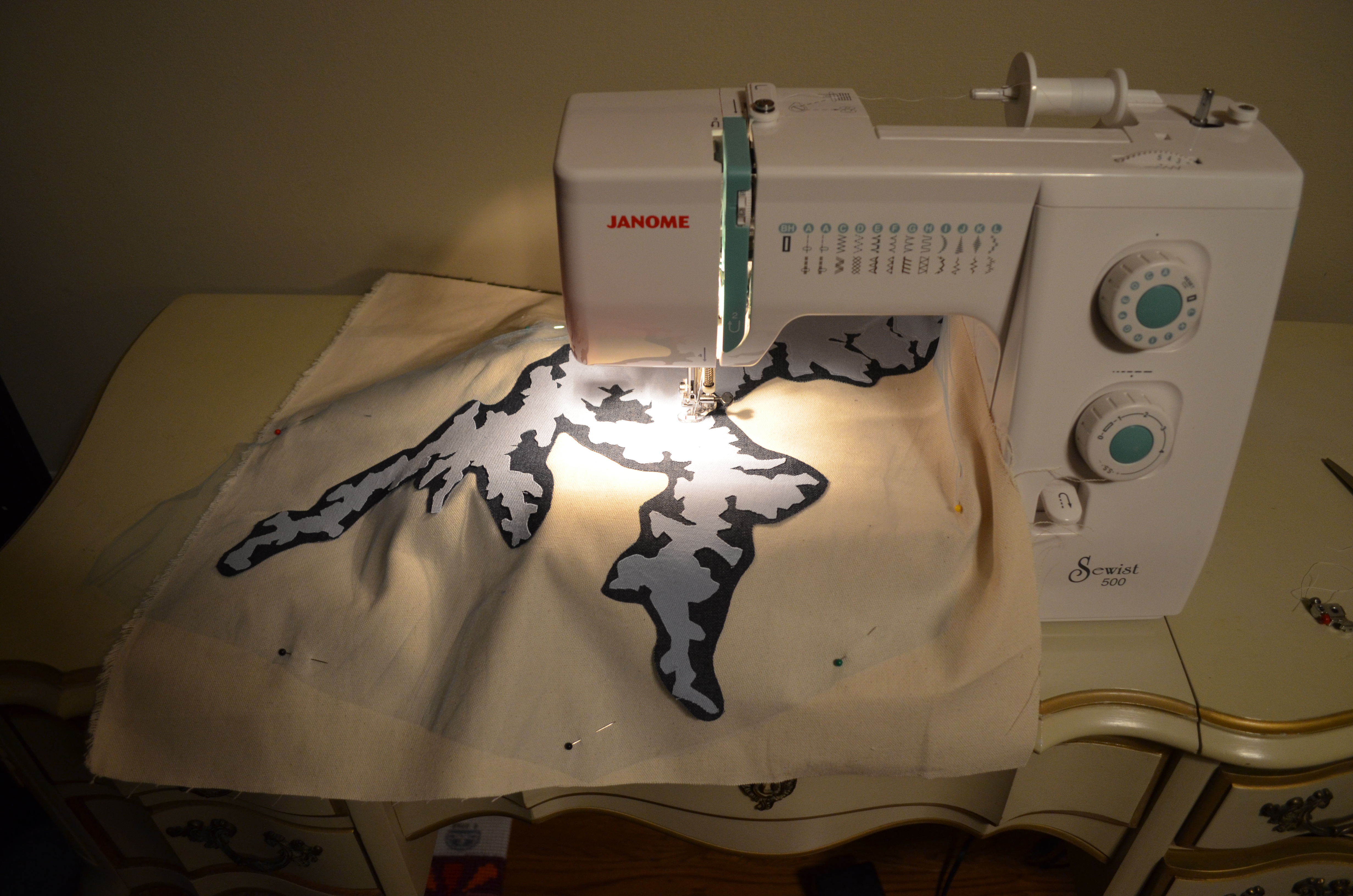
With the three layers made, I ironed the denim piece with the tulle underneath to the pillow. I then did the same with the light blue piece. With everything loosely attached, I used the embroidery foot on my sewing machine to sew everything down.

DSC_0657

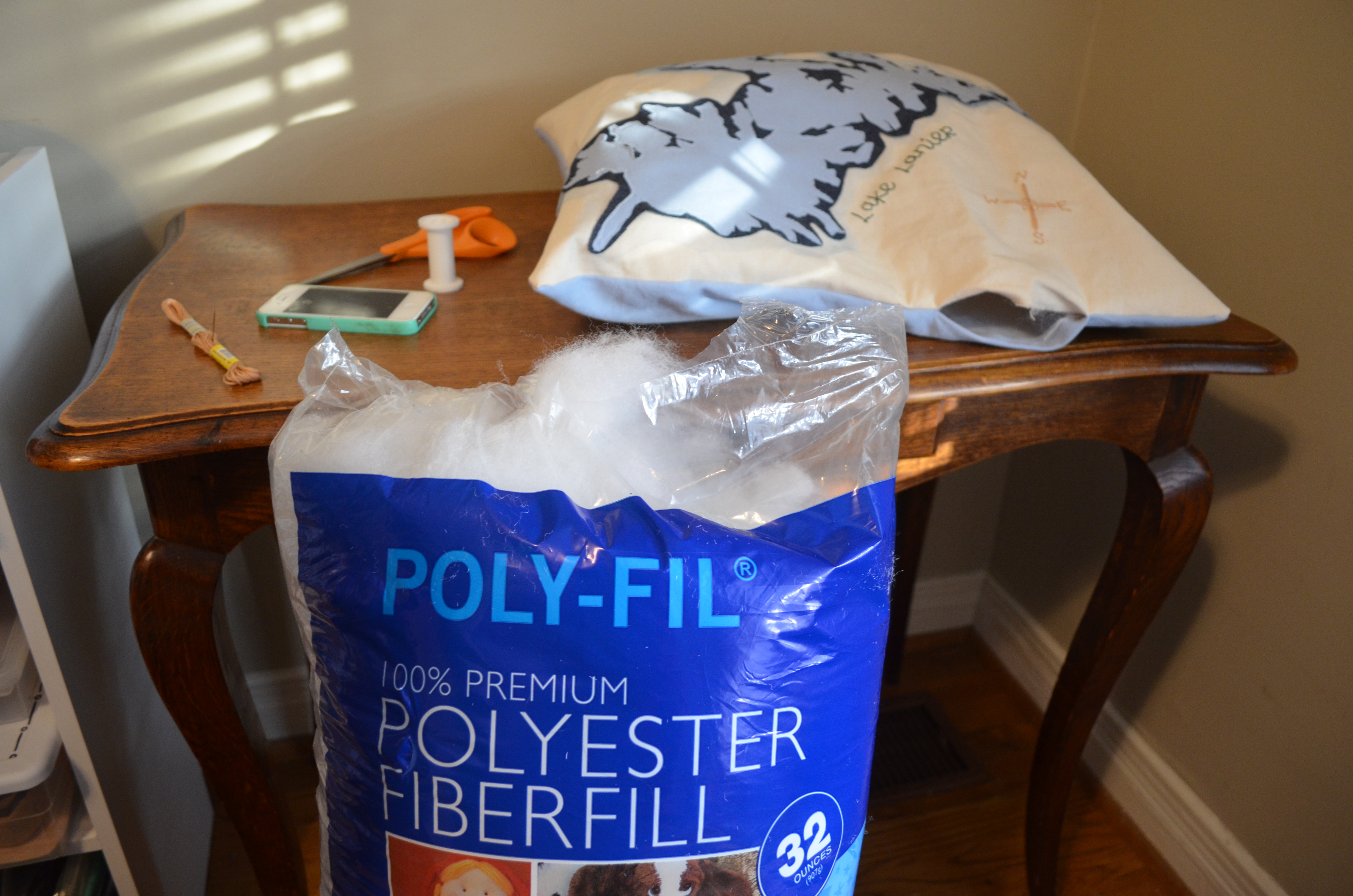
With the map in place, I added a few details, embroidering the lake’s name and a small compass. I then attached the back piece, placing right sides together and sewing along the edge with a 3/4-inch seam allowance. Leaving a small hole, I stuffed the pillow with poly-fil, and hand sewed the hole closed.

DSC_0673

It’s been awhile since I used my embroidery foot with my sewing machine, and for me, it’s take a few minutes before I feel like I have the hang on it. But even in it’s imperfect moments, I love the free-form look of this sewing foot creates. For me, it just enhances the homemade quality.

DSC_0671

After attaching the lake map, I felt like the pillow still needed something extra. I knew I wanted to embroider the lake’s name, but the idea of the compass came to me at the last minute. It was the perfect finishing touch.

DSC_0674

Overall, this pillow is of great quality. I used canvas for the front of the pillow and a thick, blue cotton fabric for the back. Both pieces were in my collect of scrap fabric, so I don’t know about cost. But I do know the fabric choice helps make the pillow feels so sturdy.

DSC_0669The pillow now lives in my parents’ kitchen in a cute sitting area they created (instead of having a kitchen table). On a good winter day, you could stand up from this spot and see the lake through the windows. I couldn’t think of a better home.


Felt Valentine’s Day Sweetheart Candies

DSC_0690

When I asked my roommate if she minded I decorated our house for Valentine’s Day, she laughed. “Just hold back on the pink,” she said.

I love Valentine’s Day! So when I started to brainstorm ideas for spring felt products for the Etsy shop, felt Sweetheart candies – right in time for Valentine’s Day – quickly came to mind.

DSC_0680

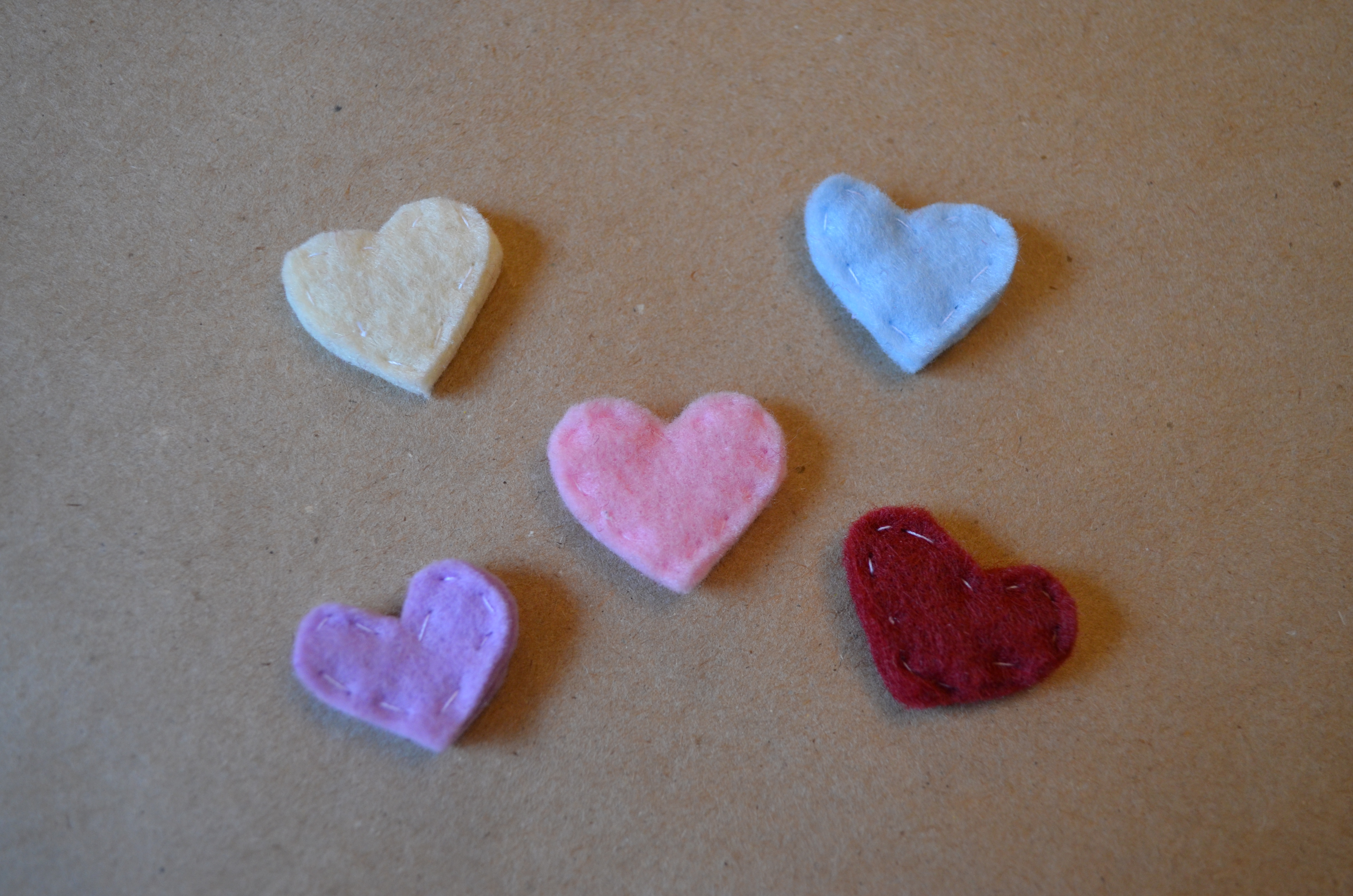
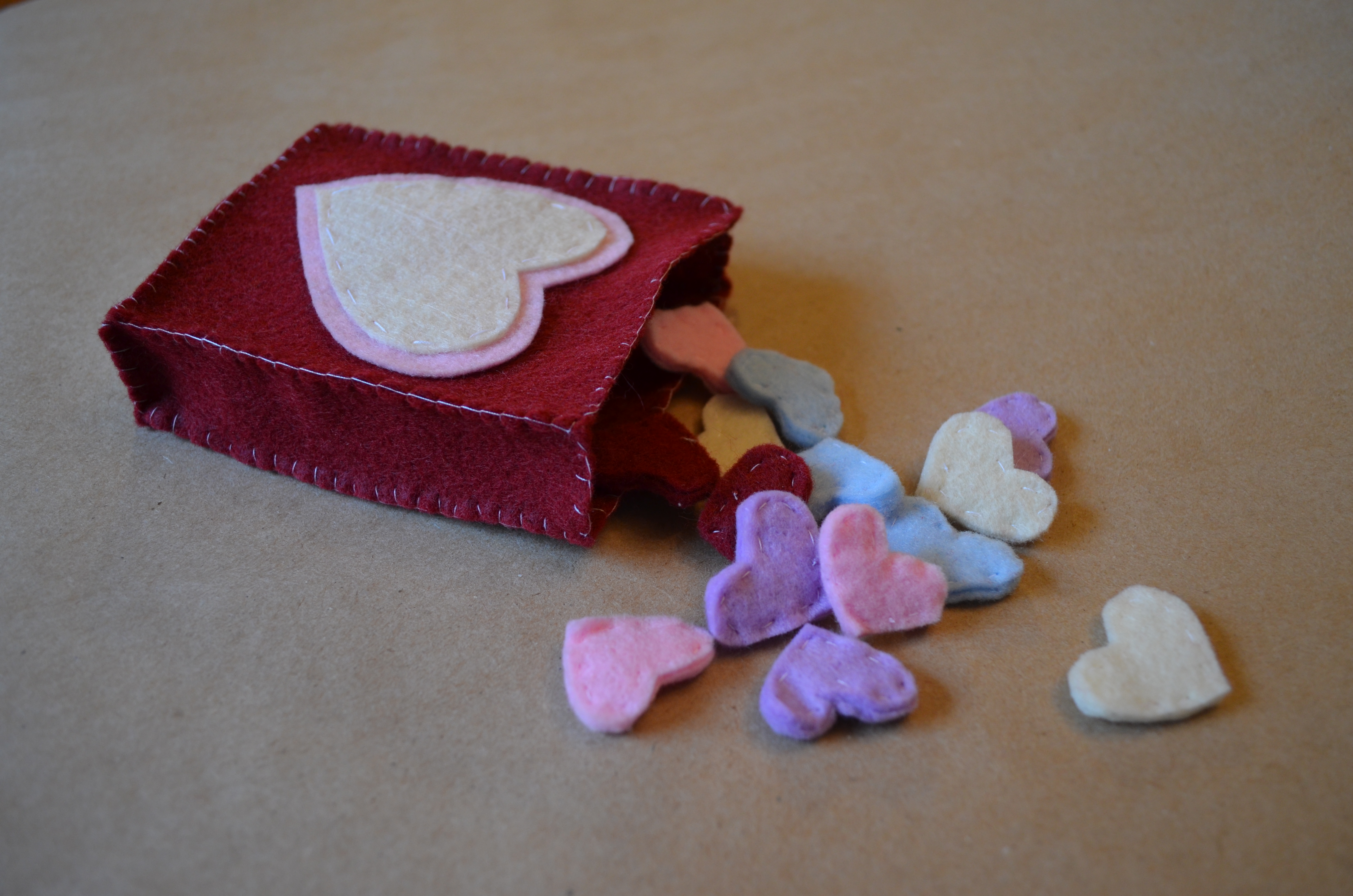
Each bag comes with 20 little felt hearts, 4 of each color. (Note: this number later seemed ridiculously high when I was working on completing 16 bags – 300 hearts total.) Each heart is actually 3 layers of felt, hand sewn together.

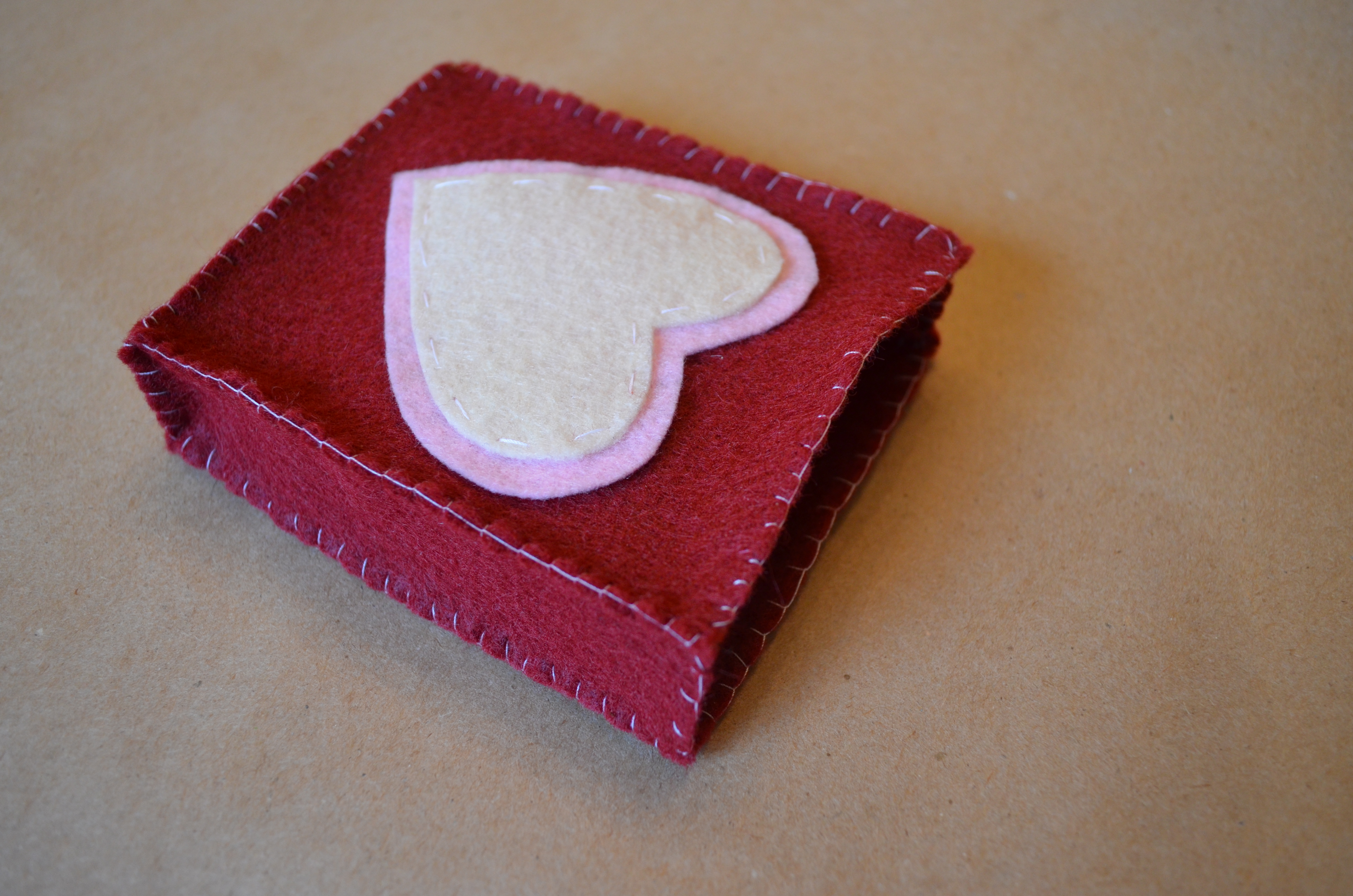
DSC_0684The felt bag – meant to replicate the Sweetheart box – is completely hand sewn using a blanket stitch. The bag has 5 pieces: the two large rectangles for the front and back, two side piece and one bottom piece. To help with size consistency, I created templates out of card stock (which is a little out of character for me!)

DSC_0685   DSC_0683

Using a blanket stitch did make the production time longer, but I think the homemade touch elevates the overall product. And so far, the product has been a major hit.

DSC_0681

So what are you waiting for? This bag of felt candy is the perfect gift for your little Valentines. Plus, you don’t have to worry about cavities!

IMG_5105   IMG_5106

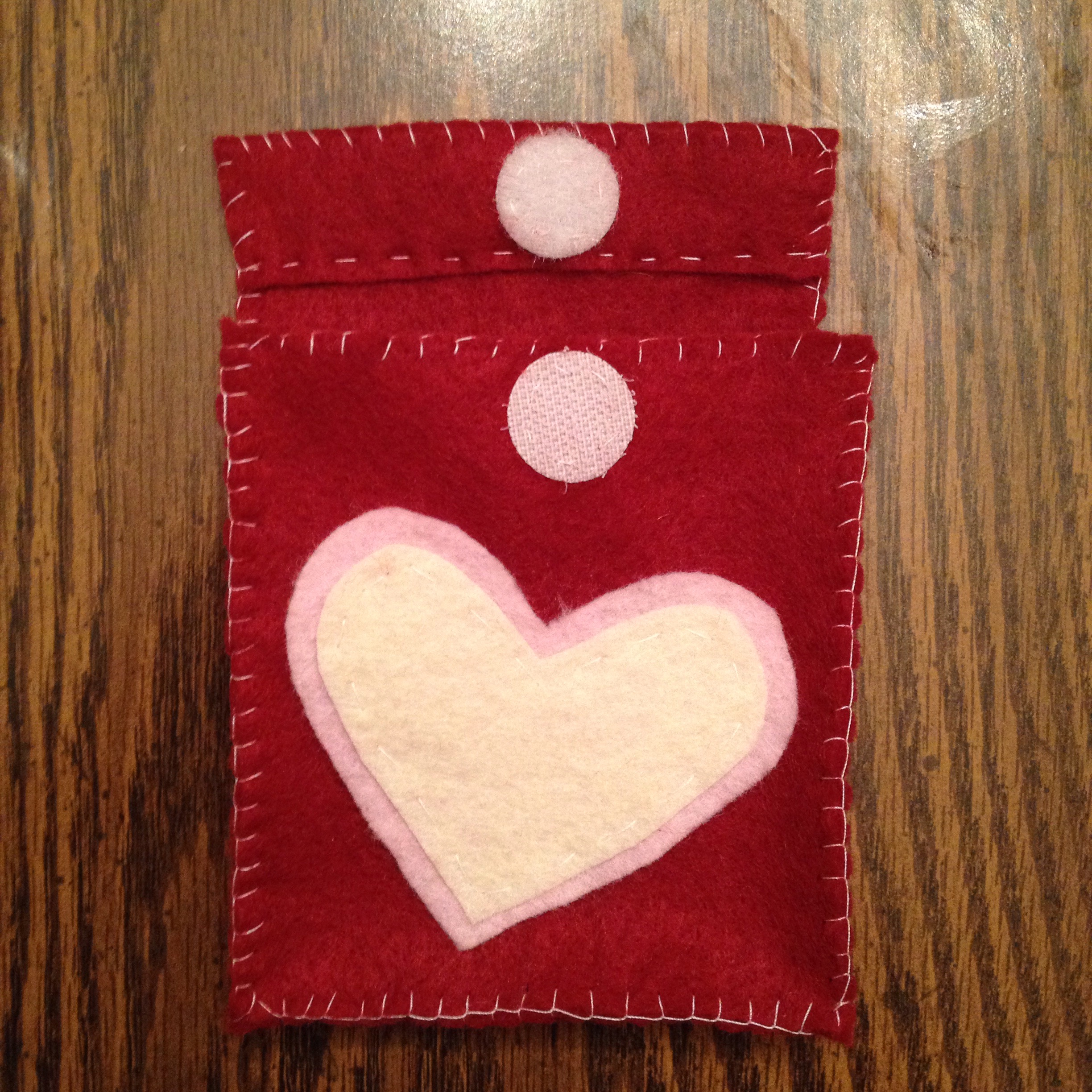
Side note: One customer asked me to create a felt bag with a flap (since she thought the felt hearts would quickly be lost otherwise). I was happy to oblige. I went back and forth about using a velcro dot (seems dangerous around felt), but (confession) it was my laziness that made the final decision. I couldn’t find a button to use around my house and I was too lazy to run to the store. Luckily, the customer didn’t mind!

Anthropologie-Inspired Felt Christmas Stocking

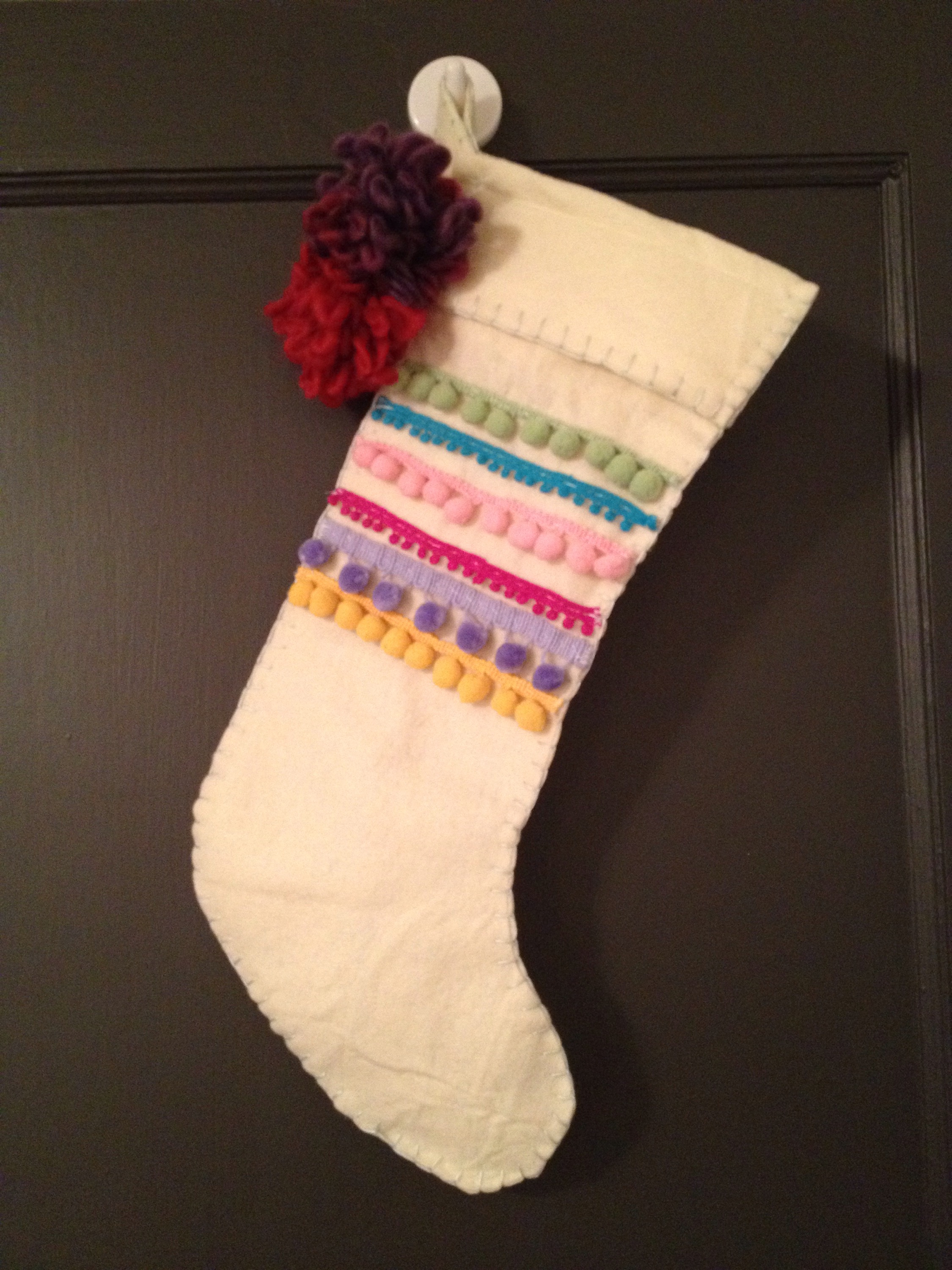
IMG_4921I know, I know. I’m writing about my Christmas stocking in the final days of January, but to my defense, this month has flown by. I’m ready to flip my calendar to February with hopeful thoughts that next month won’t be as crazy.

But back to Christmas: this year I decided I wanted to buy a nice Christmas stocking, one that I would treasure year after year. When I stumbled across this stocking at Anthropologie, I was instantly smitten, but the price tag made me think twice. The thought is almost reflexive at this point: I could totally make this!

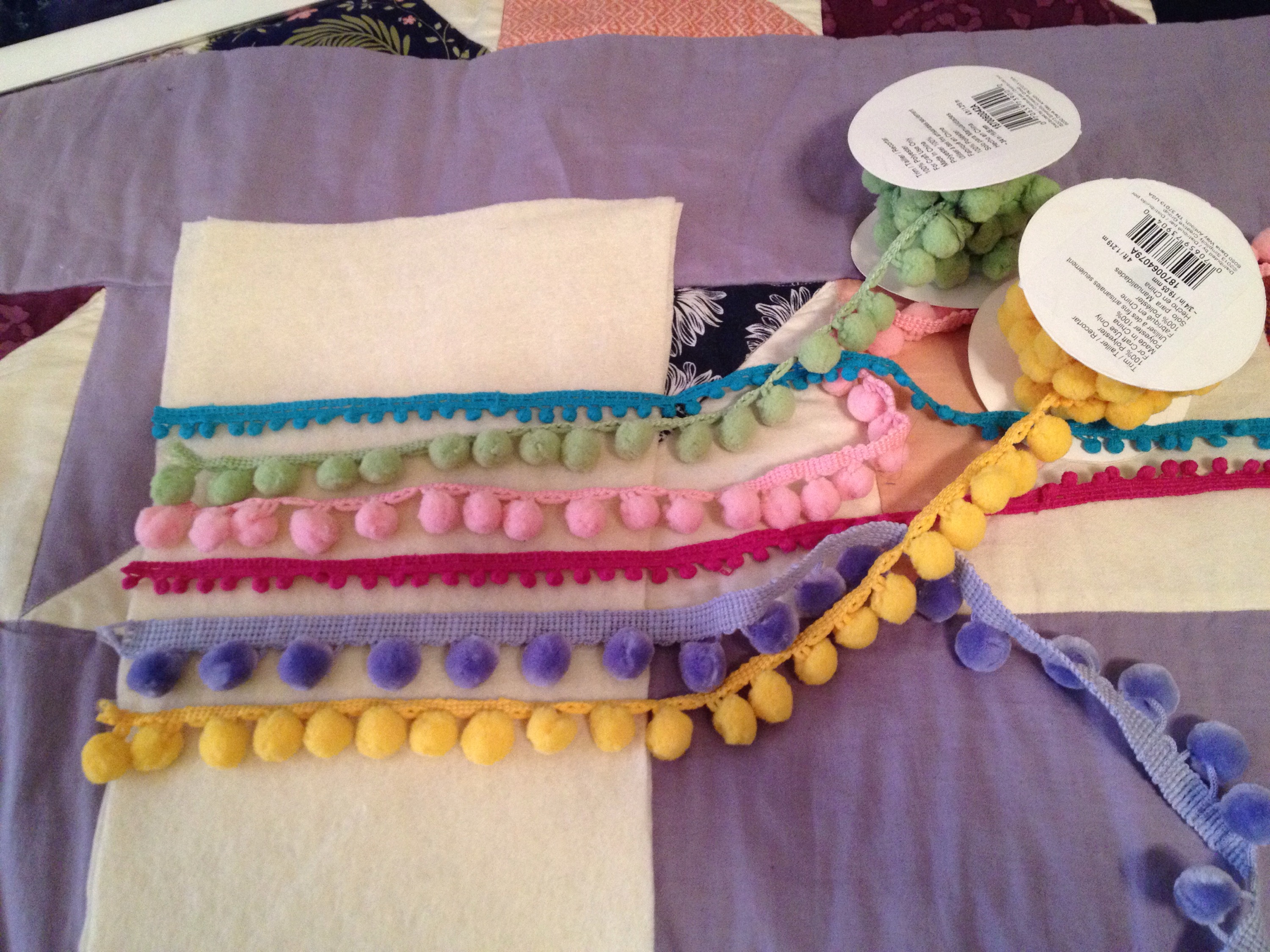
IMG_4907I’ll keep the picture of the Anthopologie stocking small because when placed side-by-side, my stocking looks pretty “crafty” in comparison. The difference is in the quality. I’m sure Anthopologie used expensive wool. I used acrylic felt from Hobby Lobby. They used these adorable mini pom poms with a trendy color pallet. I was stuck with the primary colored trim selection at JoAnn Fabrics.

Don’t get me wrong, I love how my stocking turned out, especially when you compare the price. I spent about $8. The item is now out of stock, but I remember Anthropologie selling it for almost $50.

IMG_4916

In my excitement of the project (plus, I made it really late at night and the lighting would have been a mess), I didn’t take many step-by-step pictures. But the process doesn’t venture far from a normal Christmas stocking tutorial. After cutting out the main piece of the stocking, I simply attached rows of trim. And instead of using my sewing machine, I used a blanket stitch to hand sew the stocking together. I used light blue thread to provide a little contrast.

My final touch was the accent of purple and magenta yarn pom poms. I hunted for the white yarn in the similar style, but after going to a few stores, I felt lucky to have stumbled across the purple yarn. So I made it work!

I’m sure when Christmas comes around this year, I’ll go through the same thought process of wanting a buy nice stocking. But for now, I’m excited that this Christmas stocking is mine.

Wine Bottle Christmas Decor

IMG_5031

World Market is a dangerous place. My roommate and I spend an hour last night wandering through its aisles, collecting an array of fun things for our home and our stomachs. Knowing I had a Christmas party to attend this weekend, I grabbed a bottle of wine for a hostess gift and turned to find a display of fun wine bottle decorations – like little scarfs, Christmas sweaters, etc. all sized down to fit a wine bottle.

Miniatures are simply the cutest! I picked out three different items that I was very tempted to buy. But I held back when I realize (like I often do) – I could totally make this!
And though I didn’t end up knitting a miniature scarf, I decided to make a pom pom one. Super easy and cheap to make. And as you know, I love making yarn pom pom. (See video for tutorial.)

For the Love of Gold Paint Pens

IMG_5026

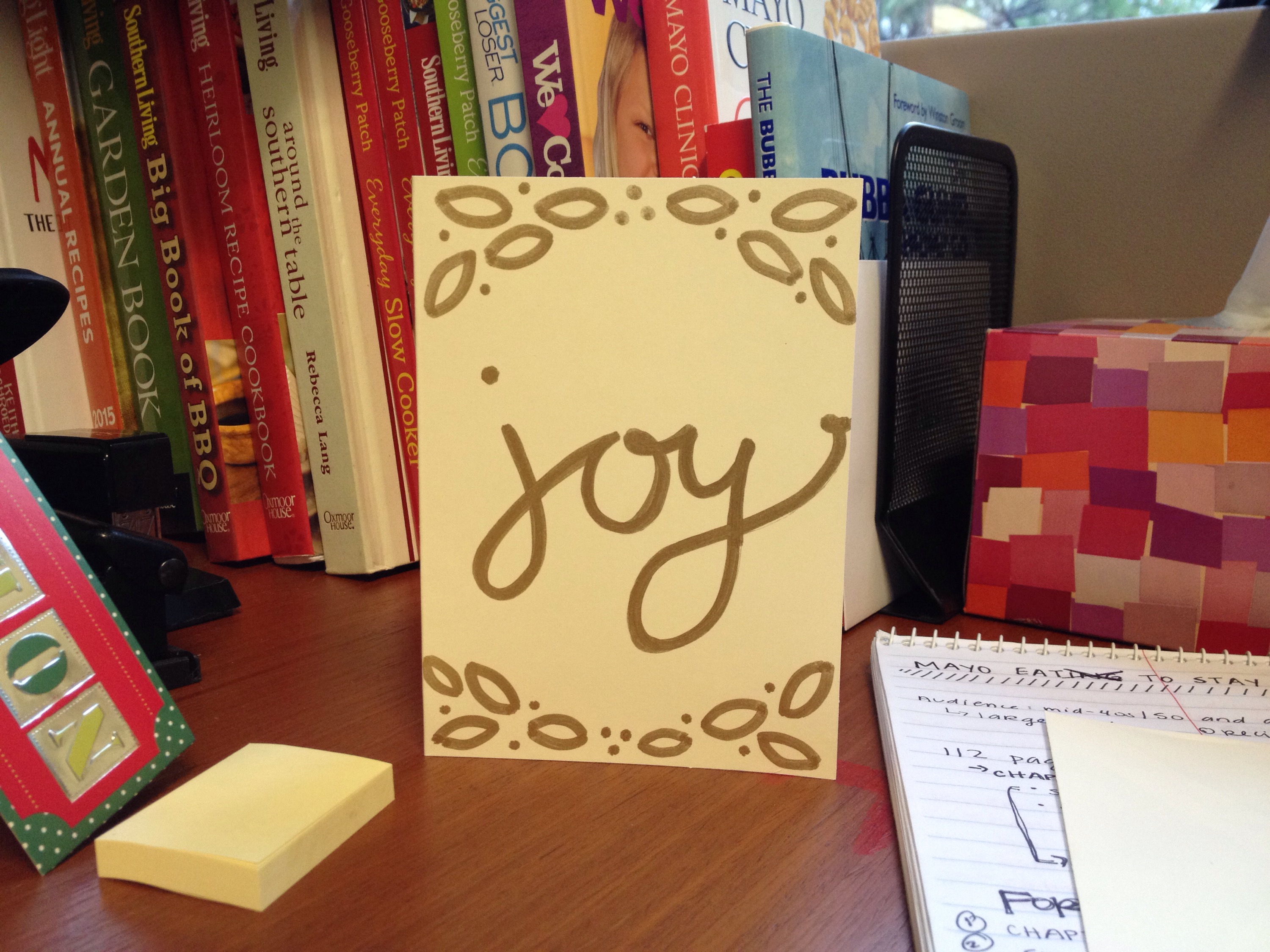
The latest craze to hit my life: the beauty of a gold paint pen. I took the pen from my parent’s house to work on a project for my Grandmother’s birthday, and I’ve been playing with it ever since.

This week, I was putting together little gifts for my co-workers, and the pen came out. (I gave a gift card for a free pop from Steel City Pops, and because that place is so clever, a gift card is a stamp Popsicle stick.) I love, love, love how these cards turned out!

IMG_5032

Hosting my Grandmother’s 80th Birthday

DSC_0600

Several months ago, my mom and I sat down to brainstorm ideas for my Grandmother’s 80th birthday. Our initial ideas were grand: a four course meal and a string quartet. But as the weeks progressed and our ideas receive feedback from our financial backer (Dad) and the guest of honor (Grandma), we decided to tone down the party. It would be a simple cocktail party with heavy hor d’oruvres and lots of friends and family.

Screen shot 2014-11-05 at 4.19.45 PM

Let’s start by taking about this amazing invitation. A link on Pinterest led me to Tiny Prints, a custom card and invitation website owned by Shutterfly. Though I initially thought this template was rather plain, I was amazed at how well it complimented the picture. This is my grandmother’s engagement portrait. (Isn’t she stunning!) The template added a cool filter, which helped make the white text stand out. Unlike some templates, this invitation left plenty of room for all of the information we wanted to include. (And it was Mom who came up with the wording, “Please no gifts – only many good wishes.” I thought it was pretty clever!)

Fifty of Grandma’s dearest friends and family were able to make it. The party took place at the retirement community Grandma lives at in its grand ballroom (which was great because the room itself was already well decorated and beautiful).

DSC_0618

We coordinated with the staff beforehand, and they had the entire room set up when we arrived. All we had to do was set up the finishing touches. The facility even had its only helium tank, making it easy (and cheap) to have lots and lots of balloons. Despite it being a cocktail party, we had enough chairs for everyone to set down. My parents hired a piano player, and as you can see below, a few couples danced (so precious!).

DSC_0603

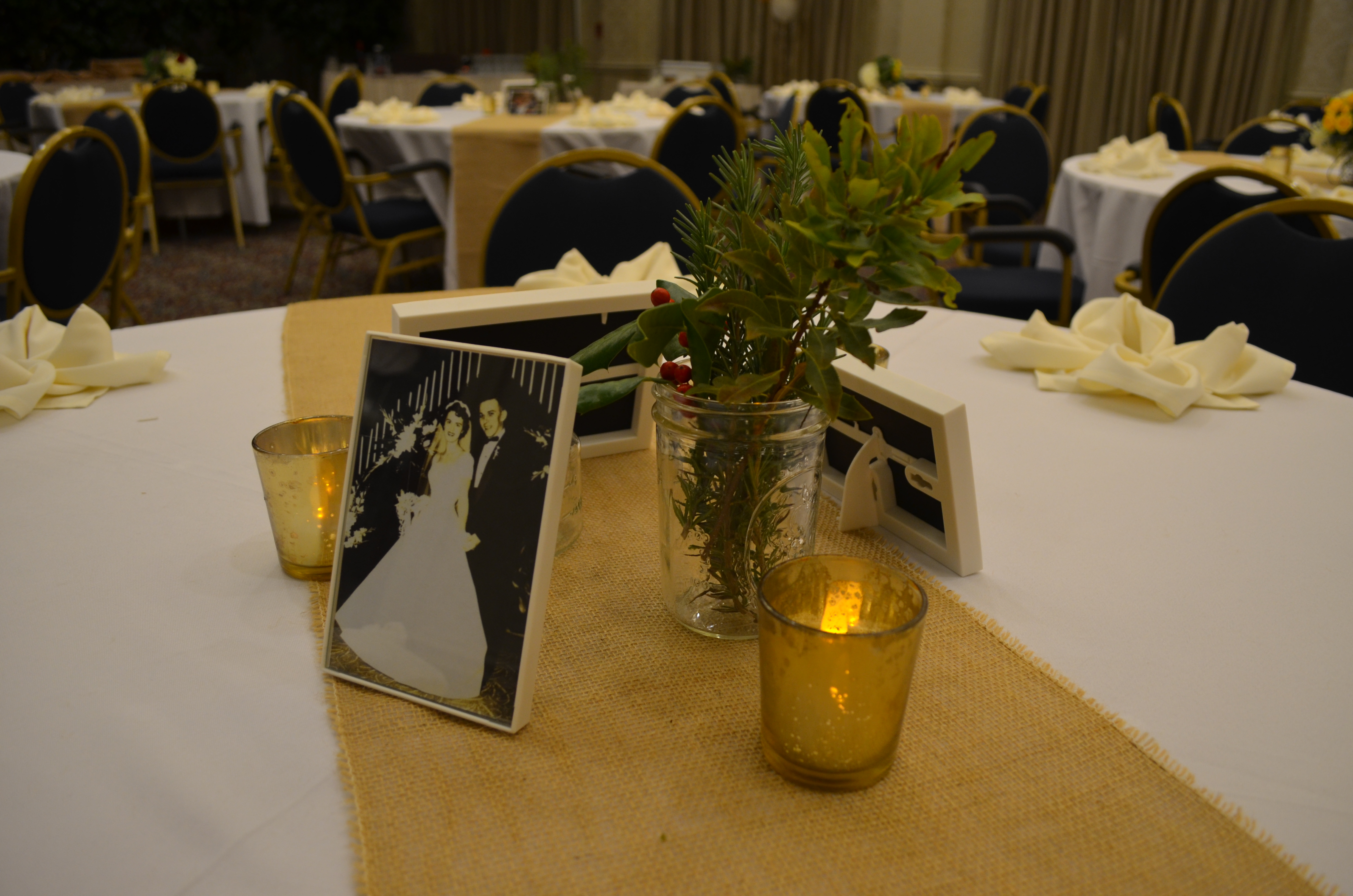
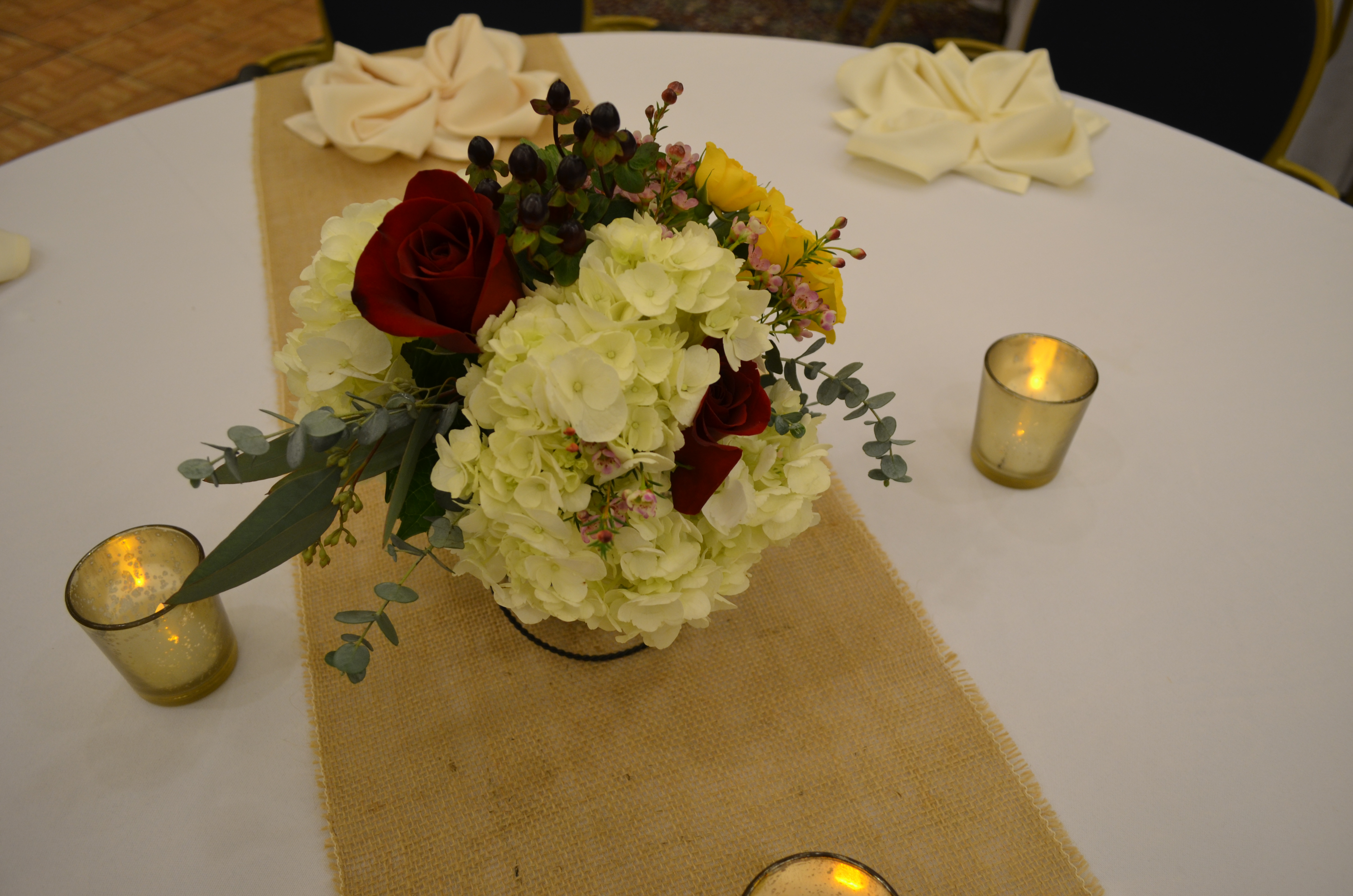
For the table decoration, we used 14-inch-wide burlap table runners at each table. Though the runners looked incredibly long when we pulled them out the box, they ended up being perfect length for the tables – only skimming the floor on either side. Each table also had three to four gold, mercury glass votives. (I purchased sets from Z Gallerie.) We weren’t allowed to use real candles, but the fake candles we purchased worked just fine.

We knew we wanted to have a florist help with the flowers, but to avoid a crazy cost, we decided to purchase only four centerpieces. My mom said she met with the florist for 45 minutes, and the woman created arrangements that were even more beautiful than we imagined. We wanted to color scheme to be white, deep reds, dark greens and purple with touches of yellow. And she did beyond an amazing job. (The picture below fails to display the head of kale she included in each arrangement.) Again, simply stunning!

DSC_0585

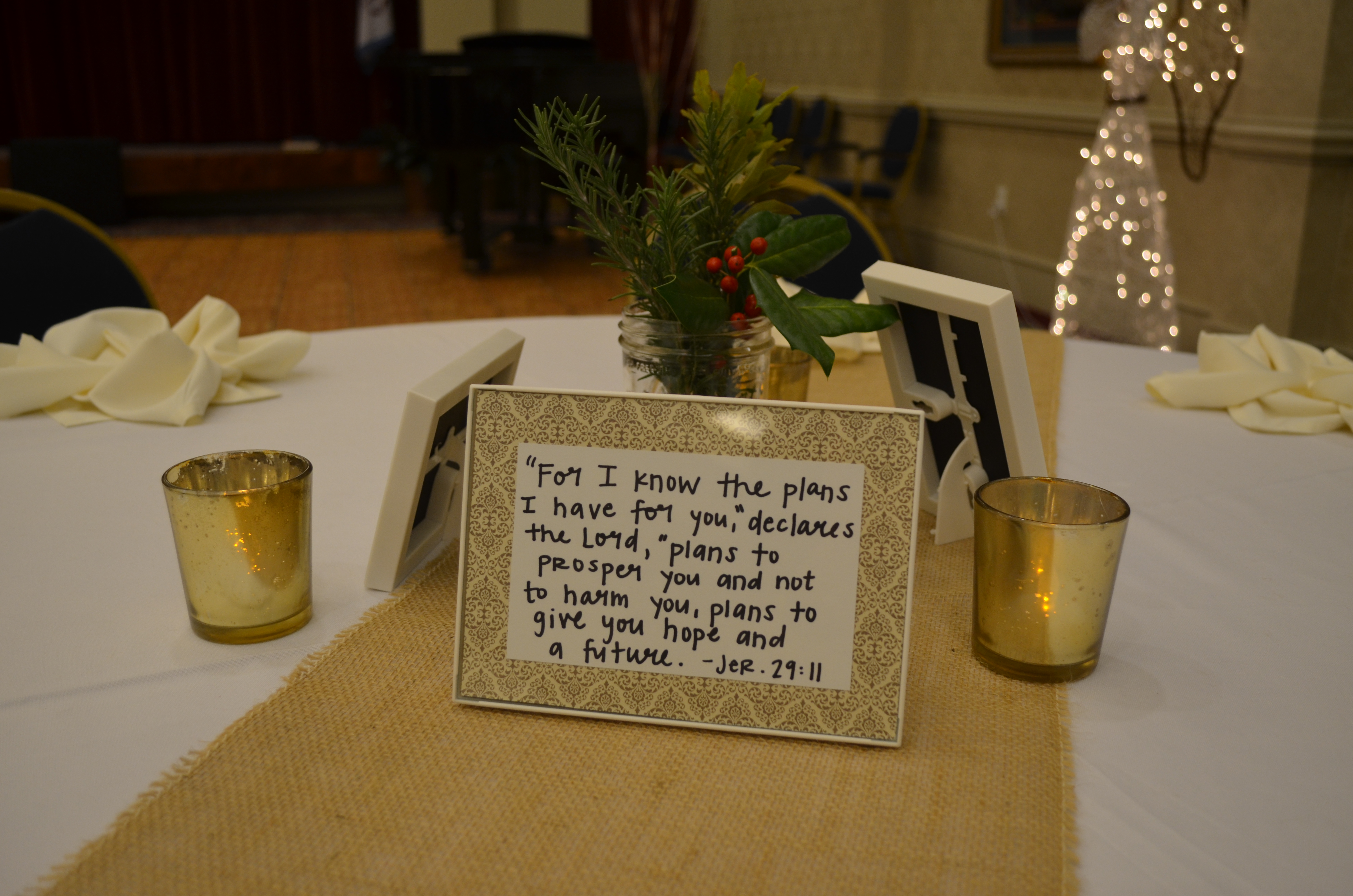
For the other tables, we filled them with pictures. I found these cheap white frames at Walmart. (Though, disclaimer, the stands that held the frames up easily fell down when someone picked them up. It probably would have been worth spending a little more to avoid this annoyance.)

Along with pictures, I also included frames with a beloved Bible verses. The one pictured below is one of my favorites.

DSC_0591

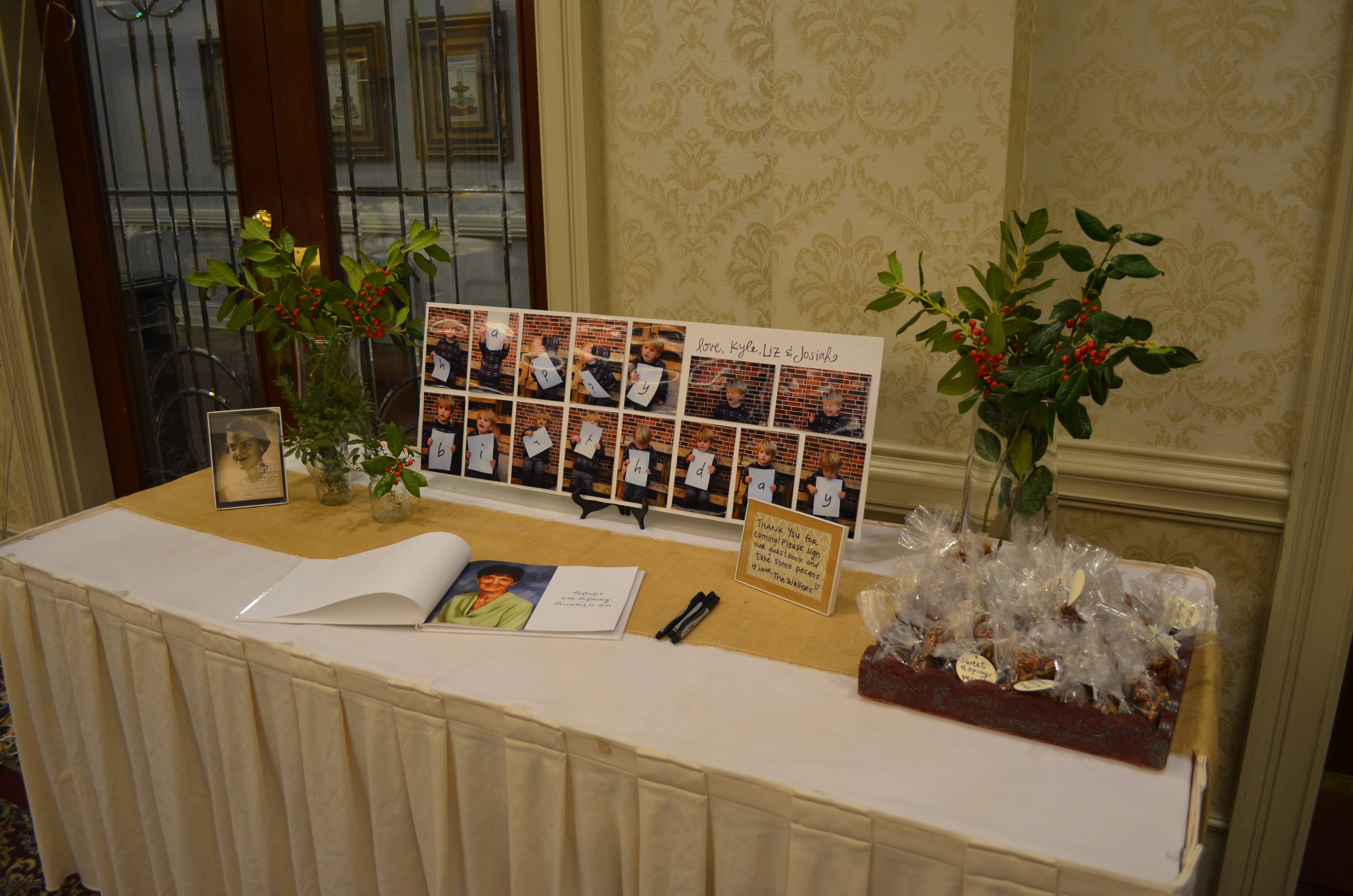
To help fill in spots, I foraged around the retirement community for lots of rosemary, holly and other interesting foliage. Using jars I brought from home, I made arrangements for the tables without flowers. And on a spare table where we set the guest book and party favors (some delicious candied pecans), I placed large vases full of holly.

These arrangements were the perfect touch to complete those “empty” spots.

DSC_0575

Using Shutterfly, we created a photo book as our guestbook. Each page had a picture of Grandma with plenty of white space for people to sign. We knew that people wouldn’t fill all 20 pages, but we figured Grandma could place cards or pictures from the night in it.

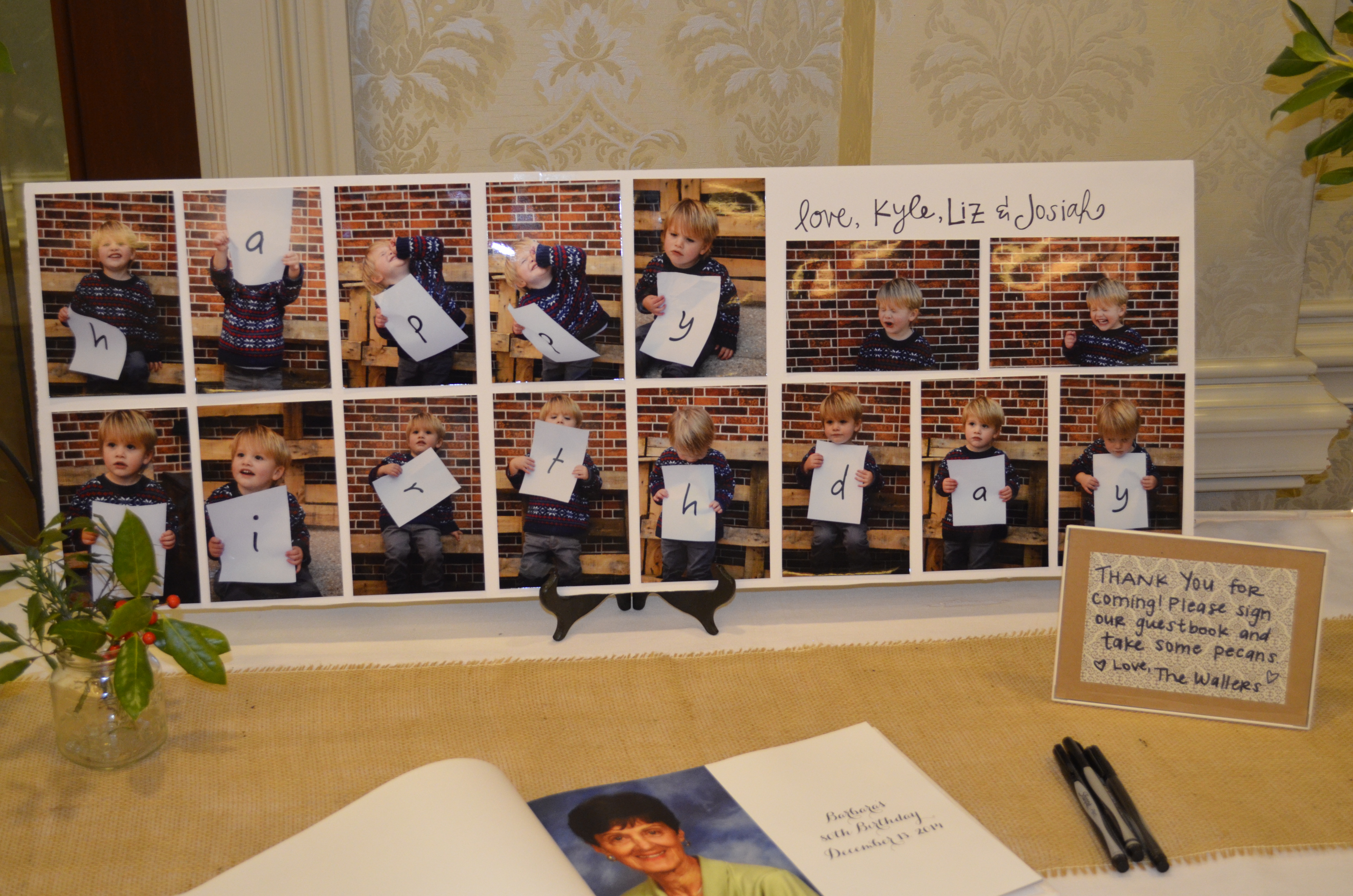
The best detail of the night was a collection of photos my sister-in-law sent of my nephew. I have distinct memories of doing this as a kid – holding up each letter and then Mom mounting them to a board. The fact is – pictures of a 2-year-old will always be a crowd pleaser!

_DSC0452

Finally, what is a birthday without cake? Mom purchased the cake from Pat-A-Cakes in Columbus, GA. The details on the flowers were spectatcuar, and it tasted even better than it looked. For a sweet touch, I made gingerbread cookies – using a B-shaped cookie cutter – to help tie in the holidays. These cookies are always a crowd pleaser.

_DSC0458

Overall, this party was a blast! It was an honor to be able to do something special for someone who means so much to me and many others. My grandmother is the kindest, most generous and supportive person I know. In her career as a nurse and still today, she spends countless hours selflessly helping so many people. And in her spare time, she can whip up the most spectacular sewing projects you have ever seen! From making clothes for my American Girl doll to teaching me how to set up my sewing machine, she has always encouraged my creative side. Plus, she’s the most avid reader on this blog. I know she’ll be reading this soon, so Grandma: Happy Birthday. I love you!